

Bhagavad Gītā · Chapter 9 · Rāja Vidyā Rāja Guhya Yoga
प्रकृतिं स्वामवष्टभ्य विसृजामि पुनः पुनः
भूतग्राममिमं कृत्स्नमवशं प्रकृतेर्वशात्
prakṛtiṃ svāmavaṣṭabhya visṛjāmi punaḥ punaḥ|
bhūtagrāmamimaṃ kṛtsnamavaśaṃ prakṛtervaśāt||
Word meanings
प्रकृतेः = of (his own) nature
वशात् = by the compulsion of
अवशम् = powerless
इमम् = this
कृत्स्नम् = entire
भूतग्रामम् = this whole multitude of beings
स्वाम् = my own
प्रकृतिम् = nature
अवष्टभ्य = having taken hold of
पुनः, पुनः = again and again
विसृजामि = I send forth
Translation
Wielding My Nature I release, again and again, (according to their respective Karmas) all this multitude of beings subject to the influence of their own nature.
Commentary
The commentators seated around this verse

Rāmānuja · Viśiṣṭādvaita
English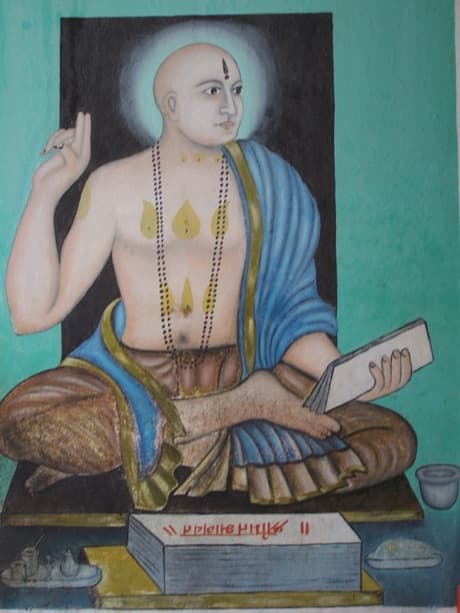
Madhvācārya · Dvaita
SanskritEnglish“प्रकृत्यवष्टम्भस्तु यथा कश्चित् समर्थोऽपि पादेन गन्तुं लीलया दण्डं अवष्टभ्य गच्छति | सर्वभूतगुणैर्युक्तं नैव त्वं ज्ञातुमर्हसि इति च मोक्षधर्मे | सर्वभूतगुणैर्युक्तं देवं त्वां ज्ञातुमर्हसि इति च | विदित्वा सप्त सूक्ष्माणि पड्डगं च महेश्वरम् | प्रधानविनियोगस्थः परं ब्रह्मदिगच्छति - इति च | न कुत्रचिच्छक्तिरनन्तरूपा विहन्यते तस्य महेश्वरस्य | तथाऽपि मायामधिगृह्य देवः प्रवर्तते सृष्टिविलायनेषु || इति ऋग्वेदखिलेषु ||” - Just as one who is capable of walking takes the help of the stick, the Lord even though capable of creating the universe on His own, uses the Nature for that purpose. “Do not consider the Lord, who is repository of all the attributes, dependent like other beings on others”, thus in Moksha Dharma. “You are entitled to, know Me who is the repository of all the attributes”. “Knowing the Supreme Lord through seven subtle forms and five subsidiary forms, the one who is equanimous goes to Supreme Brahman”. “The immeasurable power of the Supreme Lord does not get exhausted in any manner. “Even then taking the assistance of the Nature, he engages in Creation dissolution etc”, thus in Rigveda.
“मय्यनन्तगुणेऽनन्ते गुणतोऽनन्तविग्रहे || इति भागवते | अथ कस्मादुच्यते परं ब्रह्म वृहति वृहयति च || इत्याथर्वणे | पराऽस्य शक्तिविविधैव श्रूयते || इति च | विष्णोर् नु कं वीर्याणि प्र वोचं यः पार्थिवानि विममे रजांसि | .. न ते विष्णो जायमानो न जातो देव महिम्नः परं अन्तं आप || इत्यादेश्च | प्रकृतेर्वशाद्, अवशम् | त्वमेवैतत्सर्जने सर्वकर्मण्यत्यन्तशक्तोऽपि स्वमाययैव | मायावशं चावशं लोकमेतत् सक्ष्यस्यसि पाशीश विष्णो || इति गौतमखिलेषु ||” - “Each of My attributes having their own innumerable attributes and innumerable forms”, thus in Bhagavat Puraana. “Why is He referred to as Brahman? Because He being Complete makes others also Complete”, thus in Atharva Veda. His power is Supreme and multifaced”, thus in scriptures. “Who can speak of the innumerable exploits ? Even the (four-faced) Brahma capable of counting the grains of dust, is unable to do”. “O Vishnu, no one can describe your attributes, neither the ancients nor the new comers”. “Prakriti (nature) being dependent, is said to be paradheena”. “You are verily the energizer of all the actions. Without expectation of assistance of Nature, You on your Power and own, all the fourteen worlds which are dependent on Nature, are created and destroyed by You”.

Jñāneśvar · Vārkarī
EnglishOn verses 9.8–9.9
8 "Thus, holding my Cosmic Nature under my domination, I again and again send into being this entire aggregate of beings, which is rendered helpless under the control of that Cosmic Nature.
9 "These (generative) acts, however, do not, O Dhanamjaya, occasion any bondage for Me, who remain like one unconcerned, and not attached to those acts. (106)
Oh Kiriti, when I rule over the Prakriti as my own, then like a band of threads getting woven into a web by the warp and woof of small squares of the fibres, the Prakriti herself changes over into the five gross elements with name and form of the universe. Just as milk mixed with leaven clots into curds, in the same way the Prakriti bodies forth as the created universe. As the seed by contact with moisture in soil blossoms forth and gets spread out into a tree, with branches and sub-branches, in that way the universe created by the Prakriti owes its being to Me. As the saying is, the king verily makes the town, do the royal hands ever toil at that work? And indeed I rule over the Prakriti not otherwise than one who is raised from a dream into wakefulness. Now pray tell me, Oh son of Pandu, if one feels footsore in going from his dream into waking. Does one feel like being tired with anything like a journey in a dream? The truth of all this is that in the creation of all beings, not the slightest touch of action ever reaches me. As a king rules over his subjects, and each toils and carries out his task, so do I rule over the Prakriti. All action is the doing of the Prakriti: it cannot touch me. Just see, on the full-moon night, with the meeting of the moon, the sea bursts into full tide: Oh Kiriti, has the moon ever to drudge for this? The iron inert as it is, when placed near a magnet, does it not move? Does the magnet ever suffer in any way, in making the iron move? Even so, as soon as I behold the Prakriti to rule over it, the universe of created things begins to come into being. Oh Pāṇḍav, the mass of created beings is born of the Prakriti as this Earth, becomes the breeding place for the seed to germinate and issue forth creepers, leaves, etc. or as being attached to the body is the cause of childhood, youth and old age, or the clouds are the cause for sending down rains from the sky, or sleep is the cause of dream—in all these ways, Prakriti is the cause of all the aggregate of beings. Prakriti is the root cause of all moveable, immoveable, big and small, in fact of the entire mass of created universe. Therefore, acts like those of creation of the beings or sustenance can never touch My Divine Essence. Although the rays of the moon appear as spread out over the water-surface like creepers, yet the moon is not the maker of this abundance; in the same way, although all these actions in one sense have their being in Me, yet they remain distinct from me. Just as a salt dam cannot resist the rising tide of the ocean, in that way all the actions having their end in Me, cannot affect My own Personal Being. Can a cage of smoke stop the blowing wind, or can darkness pierce into the Sun's rays? Just as rain showers cannot break through the mountain valleys, in that way the acts of the Prakriti do not touch Me. Although I am the mover of all doings on the part of Prakriti, My essential being is above all actions; I neither do anything Myself nor cause anything to be done. A (burning) lamp in a house neither prompts nor prevents any one from doing a thing. It is unconcerned as to who is doing, and what is being done; it is a mere spectator, and yet it is the condition of all that is being done: Even so, though I am the source of the being of created things, still I am severally unconcerned in their actions. Enough of this repetition, Oh husband of Subhadrā, of this one simple truth! Know it now once for all.
Swami Ramsukhdas · Modern
English'Bhūtagrāmamimam kṛtsnamavaśam prakṛtervaśāt'—Here, the term 'prakṛti', stands for individual prakṛti. At final dissolution, all beings merge in individual Nature (causal bodies) and individual Nature merges into Cosmic Nature and Cosmic Nature, merges into the Lord. But, at the beginning of a creation when actions of those beings become mature to bear fruit, the Lord, thinks to become manifold from one. So, there is commotion in nature. When curd is churned, butter and butter-milk become separate. Out of this, butter flows over butter-milk. Here, butter is sāttvika, butter-milk is tamas and the action of churning is, Rajas. Similarly, from the commotion in prakṛti (Nature), also the three attributes (qualities)—goodness, activity (passion) and inertia (ignorance), are born. Out of the three modes, the heaven, this mortal world and the underworld, are born. In these three worlds, beings are born according to their actions, and nature. This description, is also given in the third and fourth verses of the fourteenth chapter. Where 'prakṛti' has been called 'Mahadbrahma', and 'the Lord's pursuit of mind to become manifold' has been declared, as 'placing the seed of all life.'
At dissolution the soul submerges into God, but it does not
attain emancipation, because it submerges being associated with modes of nature. Had it renounced its association with modes, it might have emancipated forever, and would not have undergone, the wheel of birth and death.
Attachment to these modes, is the cause of beings' birth, in good and evil bodies. So, a being remains under its control. In the nineteenth verse of the eighth chapter, there is a description of a being who remains under the control of his own individual nature. In the fifth verse of the third chapter, there is description of helplessness, under one's nature after birth. A being, is tied by these Nature-born modes, in all the three worlds, as is also described in the fifth verse of the fourteenth chapter.
'Prakṛtim svāmavaṣṭabhya'—Prakṛti (Nature) is an uncommon power of the Lord, which can neither be called different from Him, nor one with Him. The Lord, as its supervisor, keeping Nature under control, brings forth beings, at the beginning of creation, because all changes take place in nature, not in the Lord. It does not mean, that God Himself is incapable, dependent and weak, to do so.
As a man, performs actions by controlling his mind and senses etc. (But when he comes under the sway of mind and senses etc., he instead of being their master becomes, a slave to them), the Lord brings forth beings, by keeping Nature under control, without getting entangled in her.
'Visrāmi punaḥ punaḥ'—The Lord, brings forth, this whole multitude of beings in different moving and unmoving species, and different bodies. In physical bodies of some of the species, there is preponderance of the earth element, in some, of fire element, in some of the air element. Thus, the Lord creates many forms, of bodies.
Here, one point needs to be understood. The Lord, brings forth only those beings, who have become slaves to their nature, by having the affinity, of 'I' and 'mine', with personal nature
(body). On being a slave, to his personal nature, one becomes a slave to the Cosmic Nature. In case, he is not a slave to such Nature, he is not reborn at the cosmic dawn.
**Appendix**—In reality Prakṛti is not different from God. Therefore God in His integral form comprises Prakṛti. To regard God without Prakṛti is to have unipresent view of God and it is not possible.
‘Avaśam prakṛtervaśāt’—Parā prakṛti viz., the self is totally independent (established in the self). By being connected with the alien Aparā Prakṛti, the self has become dependent (established in prakṛti), otherwise it can never be dependent. Attachment to the modes is its dependence—‘kāraṇam guṇasaṅgo’sya sadasadyonijanmasu’ (Gītā 13/21).
God creates only those beings again and again who are under the sway of prakṛti (their individual nature). Those who are not under the control of prakṛti (nature) are not created (born)—‘sarge’pi nopajāyante pralaye na vyathanti ca’ (Gītā 14/2).
*Link:—A man is bound by actions, when either he is attached to them or accepts himself as the doer. But, the Lord is, not bound by actions. Why? The clarification, comes in the next verse.*
Ādi Śaṅkarācārya · Advaita
Sanskritप्रकृतिं स्वां स्वीयां अवष्टभ्य वशीकृत्य विसृजामि पुनः पुनः प्रकृतितो जातं भूतग्रामं भूतसमुदायं इमं वर्तमानं कृत्स्नं समग्रं अवशम् अस्वतन्त्रम्, अविद्यादिदोषैः परवशीकृतम्, प्रकृतेः वशात् स्वभाववशात् ॥ तर्हि तस्य ते परमेश्वरस्य, भूतग्रामं इमं विषमं विदधतः, तन्निमित्ताभ्यां धर्माधर्माभ्यां सम्बन्धः स्यादिति, इदं आह भगवान् --
Ādi Śaṅkarācārya · Advaita
Hindiअपनी प्रकृतिको वशमें करके, मैं प्रकृतिसे उत्पन्न हुए इस विद्यमान समग्र अस्वतन्त्र भूतसमुदायको, जो कि स्वभाववश अविद्यादि दोषोंसे परवश हो रहा है, बारम्बार रचता हूँ
Jñāneśvar · Vārkarī
Marathiतरी हेचि प्रकृति किरिटी । मी स्वकीया सहजें अधिष्ठीं । तेथ तंतुसमवायपटीं । जेविं विणावणी दिसे ॥ १०६ ॥
मग तिये विणावणीचेनि आधारें । लहानां चौकडियां पटत्व भरे । तैसी पंचात्मके आकारें । प्रकृतिचि होये ॥ १०७ ॥
जैसें विरजणियाचेनि संगें । दूधचि आटेजों लागे । तैशी प्रकृति आंगा रिगे । सृष्टिपणाचिया ॥ १०८ ॥
बीज जळाचि जवळीक लाहे । आणि तेंचि शाखोपशाखीं होये । तैसें मज करणें आहे । भूतांचे हें ॥ १०९ ॥
अगा नगर हें रायें केलें । या म्हणणया साचपण कीर आलें । परि निरुतें पाहतां काय शिणले । रायाचे हात ॥ ११० ॥
आणि मी प्रकृति अधिष्ठीं तें कैसें । जैसा स्वप्नीं जो असे । मग तोचि प्रवेशे । जागृतावस्थे ॥ १११ ॥
तरि स्वप्नौनि जागृती येतां । काय पाय दुखती पंडुसुता । कीं स्वप्नामाजीं असतां । प्रवासु होय ॥ ११२ ॥
या आघवियाचा अभिप्रावो कायी । जे हें भूतसृष्टीचें कांहीं । मज एकही करणें नाहीं । ऐसाचि अर्थु ॥ ११३ ॥
जैशी रायें अधिष्ठिली प्रजा । व्यापारे आपुलालिया काजा । तैसा प्रकृतिसंगु माझा । येर करणें तें इयेचें ॥ ११४ ॥
पाहें पां पूर्णचंद्राचिये भेटी । समुद्र भरतें अपार दाटी । तेथ चंद्रासि काय किरीटी । उपखा पडे ॥ ११५ ॥
जड परि जवळिका । लोह चळे तरि चळो कां । कवणु शीणु भ्रामका । सन्निधानाचा ॥ ११६ ॥
किंबहुना यापरी । मी निजप्रकृति अंगीकारीं । आणि भूतसृष्टी एकसरी । प्रसवोंचि लागे ॥ ११७ ॥
जो हा भूतग्रामु आघवा । असे प्रकृतिआधीन पांडवा । जैसी बीजाचिया वेलपालवा । समर्थ भूमि ॥ ११८ ॥
नातरि बाळादिकां वयसां । गोसावी देहसंगु जैसा । अथवा घनावळी आकाशा । वार्षियें जेवीं ॥ ११९ ॥
कां स्वप्नासि कारण निद्रा । तैसी प्रकृति हे नरेंद्रा । या अशेषाहि भूतसमुद्रा । गोसाविणी गा ॥ १२० ॥
स्थावरा आणि जंगमा । स्थूळा अथवा सूक्ष्मा । हे असो भूतग्रामा । प्रकृतिचि मूळ ॥ १२१ ॥
म्हणोनि भूतें हन सृजावीं । कां सृजिलीं प्रतिपाळावीं । इयें करणीं न येती आघवीं । आमुचिया आंगा ॥ १२२ ॥
जळीं चंद्रिकेचिया पसरती वेली । ते वाढी चंद्रे नाहीं वाढविली । तेवि मातें पावोनि ठेलीं । दुरी कर्में ॥ १२३ ॥
Jñāneśvar · Vārkarī
Hindi(9.106) हे किरीटी! मैं स्वभावतः इस प्रकृति को आश्रय देता हूँ। जैसे तन्तु के समुदाय रूपी वस्त्र में बुनावट ही रहती है,
(9.107) और इस बुनावट के आधार से जिस तरह एक छोटा चारखाना तैयार होते होते थान तैयार होते हैं, वैसे ही जब मैं स्वभावतः इस प्रकृति को आश्रय देता हूँ तब पंचभूतात्मक आकार के रूप से प्रकृति ही उत्पन्न होती है।
(9.108) जैसे जामन के संग से दूध भी जमने लगता है वैसे ही प्रकृति भी सृष्टिरूप हो जाती है। (9.109) बीज को जल का सान्निध्य प्राप्त हो तो वही जैसे शाखा और उपशाखारूप हो जाता है वैसे ही इन प्राणिमात्रों की उत्पत्ति मेरे कारण ही होती है।
(9.110) अजी, यह बात निश्चय से सत्य है कि नगर राजा का बसाया है परन्तु वास्तव में क्या के हाथों को कष्ट होता है?
(9.111) वैसे ही मैं प्रकृति को आश्रय देता हूँ। वह किस प्रकार है? जैसे जो स्वप्न देखनेहारा है वही फिर जागृति में प्रवेश करे
(9.112) तो स्वप्न से जागृति में आने से हे पाण्डुसुत! क्या पाँवों को पीड़ा होती है? अथवा स्वप्न में रहना क्या कोई प्रवास करना है?
(9.113) इन सब बातों का अभिप्राय क्या है? इनका यह अर्थ है कि इस सृष्टि की रचना के लिए मुझे कुछ नहीं करना पड़ता।
(9.114) जैसे राजा के आश्रय से रहनेवाली प्रजा अपने अपने मतलब के व्यापार करती रहती है, वैसा ही मेरा और प्रकृति का सम्बन्ध है। कर्म करनेहारी प्रकृति ही है।
(9.115) देखो, पूर्णचन्द्र की भेंट होते ही समुद्र में ज्वार-भाटा भर जाता है, हे किरीटी! उस समय क्या चन्द्र को कोई श्रम होता है? (9.116) लोहा जड़ है परन्तु चुम्बक के पास रहने से उसे गति प्राप्त होती है। परन्तु चुम्बक का पास रहना क्या कोई कष्ट उठाना है?
(9.117) बहुत क्या कहूँ, इस प्रकार ज्योंही मैं अपनी प्रकृति का अंगीकार करता हूँ, त्योंही एकदम सृष्टि उत्पन्न होने लगती है।
(9.118) हे पाण्डव, यह जो सम्पूर्ण प्राणि-समुदाय है सो प्रकृति के अधीन है, जैसे कि बीत से बेल और पल्लव उत्पन्न करने के लिए भूमि ही समर्थ है
(9.119) अथवा जैसे शरीरसंग ही बाल, तरुण इत्यादि अवस्थाओं का कारण है, अथवा जैसे आकाश की मेघमाला वर्षा के लिए कारण है,
(9.120) अथवा स्वप्न का कारण जैसे निद्रा है, वैसे ही हे नरेन्द्र! इस अशेष भूत-समुद्र की स्वामिनी प्रकृति है।
(9.121) स्थावर और जंगम का, स्थूल और सूक्ष्म का, बहुत क्या कहें, इस सब भूतग्राम का मूल प्रकृति ही है।
(9.122) इसलिए प्राणियों का उत्पन्न करना, अथवा जो उत्पन्न हुए हैं, उनका प्रतिपाल करना आदि कार्य हमसे सम्बन्ध नहीं रखते। (9.123) जैसे चन्द्रमा जल में चन्द्रिका की वेला के विस्तार का कार्य स्वयं न कर दूर रहता है, वैसे ही जिन्हें मेरी प्राप्ति हो जाती है, वे सब कर्मों से दूर रहते हैं।

Sri Udiya Baba · Modern
Hindiभावार्थ— अपनी प्रकृति का आश्रय लेकर मैं प्रकृति के अधीन होने के कारण अस्वतन्त्र उन समस्त भूत समुदाय को पुनः पुनः रचता रहता हूँ।
व्याख्या— सिद्धान्ततः तो प्रकृति की सत्ता है नहीं, किन्तु जिज्ञासु को समझाने के लिये व्यावहारिक रूप से उसका आरोप कर लिया जाता है। भगवान् से सृष्टि की उत्पत्ति वास्तव में तो होती नहीं, किन्तु जिज्ञासु की दृष्टि से दृश्य-प्रपञ्च की सत्ता अकस्मात् भी नहीं होती। इसलिये प्रकृति की व्यावहारिकी सत्ता स्वीकार करके उसे बोध कराने का प्रयत्न किया जाता है। इस बात को दृष्टान्त द्वारा समझाते हैं। जैसे सूर्योदय होने से कमल खिल जाता है, किन्तु सूर्य स्वयं उसे खिलाने की क्रिया नहीं करता। तथापि यह स्वीकार किया जाता है कि सूर्य की शक्ति ही कमल को खिलाती है। उसी प्रकार यद्यपि भगवान् सृष्टि-प्रलय आदि कुछ नहीं करते, फिर व्यवहार में सृष्टि-प्रलय आदि देखे जाते हैं; अतः ऐसा आरोप किया जाता है कि ये भगवान् की शक्ति या प्रकृति के द्वारा ही होते हैं। इस प्रकार सृष्टि तो प्रकृति के अधीन है किन्तु प्रकृति भगवान के अधीन है। इसका उन पर कोई प्रभाव नहीं पड़ता। यही बात अगले श्लोक से कहते हैं।
Swami Ramsukhdas · Modern
Hindi‘भूतग्राममिमं कृत्स्नमवशं प्रकृते-र्वशात्’—यहाँ ‘प्रकृति’ शब्द व्यष्टि प्रकृतिका वाचक है। महाप्रलयके समय सभी प्राणी अपनी व्यष्टि प्रकृति-(कारणशरीर-) में लीन हो जाते हैं, व्यष्टि प्रकृति समष्टि प्रकृतिमें लीन होती है और समष्टि प्रकृति परमात्मामें लीन हो जाती है। परन्तु जब महासर्गका समय आता है, तब जीवोंके कर्म फल देनेके लिये उन्मुख हो जाते हैं। उस उन्मुखताके कारण भगवान्में ‘बहु स्यां प्रजायेय’ (छान्दोग्य ६।२।३)—यह संकल्प होता है, जिससे समष्टि प्रकृतिमें क्षोभ (हलचल) पैदा हो जाता है। जैसे, दहीको बिलोया जाय तो उसमें मक्खन और छाछ—ये दो चीजें पैदा हो जाती हैं। मक्खन तो ऊपर आ जाता है और छाछ नीचे रह जाती है। यहाँ मक्खन सात्त्विक है, छाछ तामस है और बिलोनारूप क्रिया राजस है। ऐसे ही भगवान्के संकल्पसे प्रकृतिमें क्षोभ हुआ तो प्रकृतिसे सात्त्विक, राजस और तामस—ये तीनों गुण पैदा हो गये। उन तीनों गुणोंसे स्वर्ग, मृत्यु और पाताल—ये तीनों लोक पैदा हुए। उन तीनों लोकोंमें भी अपने-अपने गुण, कर्म और स्वभावसे सात्त्विक, राजस और तामस जीव पैदा हुए अर्थात् कोई सत्त्व-प्रधान हैं, कोई रजःप्रधान हैं और कोई तमःप्रधान हैं।
इसी महासर्गका वर्णन चौदहवें अध्यायके तीसरे-चौथे श्लोकोंमें भी किया गया है। वहाँ परमात्माकी प्रकृतिको ‘महद्ब्रह्म’ कहा गया है और परमात्माके अंश जीवोंका अपने-अपने गुण, कर्म और स्वभावके अनुसार प्रकृतिके साथ विशेष सम्बन्ध करा देनेको बीज-स्थापन करना कहा गया है।
ये जीव महाप्रलयके समय प्रकृतिमें लीन हुए थे, तो तत्त्वतः प्रकृतिका कार्य प्रकृतिमें लीन हुआ था और
परमात्माका अंश—चेतन-समुदाय परमात्मामें लीन हुआ था। परन्तु वह चेतन-समुदाय अपने गुणों और कर्मोंके संस्कारोंको साथ लेकर ही परमात्मामें लीन हुआ था, इसलिये परमात्मामें लीन होनेपर भी वह मुक्त नहीं हुआ। अगर वह लीन होनेसे पहले गुणोंका त्याग कर देता, तो परमात्मामें लीन होनेपर सदाके लिये मुक्त हो जाता, जन्म-मरणरूप बन्धनसे छूट जाता। उन गुणोंका त्याग न करनेसे ही उसका महासर्गके आदिमें अलग-अलग योनियोंके शरीरोंके साथ सम्बन्ध हो जाता है अर्थात् अलग-अलग योनियोंमें जन्म हो जाता है।
अलग-अलग योनियोंमें जन्म होनेमें इस चेतन-समुदायकी व्यष्टि प्रकृति अर्थात् गुण, कर्म आदिमें माने हुए स्वभावकी परवशता ही कारण है। आठवें अध्यायके उन्नीसवें श्लोकमें जो परवशता बतायी गयी है, वह भी व्यष्टि प्रकृतिकी है। तीसरे अध्यायके पाँचवें श्लोकमें जो अवशता बतायी गयी है, वह जन्म होनेके बादकी परवशता है। यह परवशता तीनों लोकोंमें है। इसी परवशताका चौदहवें अध्यायके पाँचवें श्लोकमें गुणोंकी परवशताके रूपमें वर्णन हुआ है।
‘प्रकृतिं स्वामवष्टभ्य’—प्रकृति परमात्माकी एक अनिर्वचनीय अलौकिक विलक्षण शक्ति है। इसको परमात्मासे भिन्न भी नहीं कह सकते और अभिन्न भी नहीं कह सकते। ऐसी अपनी प्रकृतिको स्वीकार करके परमात्मा महासर्गके आदिमें प्रकृतिके परवश हुए जीवोंकी रचना करते हैं।
परमात्मा प्रकृतिको लेकर ही सृष्टिकी रचना करते हैं, प्रकृतिके बिना नहीं। कारण कि सृष्टिमें जो परिवर्तन होता है, उत्पत्ति-विनाश होता है, वह सब प्रकृतिमें ही होता है,
भगवानमें नहीं। अतः भगवान् क्रियाशील प्रकृतिको लेकर ही सृष्टिकी रचना करते हैं। इसमें भगवान्की कोई असमर्थता, पराधीनता, अभाव, कमजोरी आदि नहीं है।
जैसे मनुष्यके द्वारा विभिन्न कार्य होते हैं, तो वे विभिन्न करण, उपकरण, इन्द्रियों और वृत्तियोंसे होते हैं। पर यह मनुष्यकी कमजोरी नहीं है, प्रत्युत यह उसका इन करण, उपकरण आदिपर आधिपत्य है, जिससे वह इनके द्वारा कर्म करा लेता है। (हाँ, मनुष्यमें यह कमी है कि वह उन कर्मोंको अपना और अपने लिये मान लेता है, जिससे वह लिप्त हो जाता है अर्थात् अधिपति होता हुआ भी गुलाम हो जाता है।) ऐसे ही भगवान् सृष्टिकी रचना करते हैं तो उनका प्रकृतिपर आधिपत्य ही सिद्ध होता है। पर आधिपत्य होनेपर भी भगवान्में लिप्तता आदि नहीं होती।
**परिशिष्ट भाव**—तत्त्वसे प्रकृति भगवान्से अभिन्न है। अतः वास्तवमें भगवान्का स्वरूप प्रकृतिसहित ही है। भगवान्को प्रकृतिरहित मानना उनको एकदेशीय मानना है, जो सम्भव ही नहीं है।
**‘अवशं प्रकृतेवशात्’**—परा प्रकृति अर्थात् स्वयं सर्वथा स्वतन्त्र (स्वस्थ) है। विजातीय अपरा प्रकृतिके साथ सम्बन्ध जोड़नेसे ही वह परतन्त्र (प्रकृतिस्थ) हुआ है, अन्यथा वह परतन्त्र हो सकता ही नहीं। गुणोंका संग होना ही परतन्त्रता है—**‘कारणं गुणसंगोऽस्य सदसद्योनिजन्मसु’** (गीता १३। २१)।
जो प्रकृतिके वशमें (अवश) हैं, उन्हीं प्राणियोंकी भगवान् बार-बार रचना करते हैं। जो प्रकृतिके वशमें (अवश) नहीं हैं, उनकी रचना नहीं होती—**‘सर्गेऽपि नोपजायन्ते प्रलये न व्यथन्ति च’** (गीता १४। २)।
**सम्बन्ध**—आसक्ति और कर्तृत्वाभिमानपूर्वक कर्म करनेसे मनुष्य कर्मोंसे बँध जाता है। भगवान् बार-बार सृष्टि-रचनारूप कर्म करनेसे भी क्यों नहीं बँधते? इसका उत्तर भगवान् आगेके श्लोकमें देते हैं।
**न च मां तानि कर्माणि निबध्नन्ति धनञ्जय।**
“I develop it eightfold and send forth this fourfold aggregate of beings; gods, animals, humans and inanimate things, time after time. All these entities are helpless, being under the sway of Prakṛti comprising the three Gunas which cause delusion.”
If this is so, it may be argued that the inequalities of creation are due to the Lord being cruel or partial etc. To this, the Lord answers: —