

Bhagavad Gītā · Chapter 7 · Jñāna Vijñāna Yoga
साधिभूताधिदैवं मां साधियज्ञं च ये विदुः
प्रयाणकालेऽपि च मां ते विदुर्युक्तचेतसः
sādhibhūtādhidaivaṃ māṃ sādhiyajñaṃ ca ye viduḥ|
prayāṇakāle'pi ca māṃ te viduryuktacetasaḥ||
Word meanings
ये = those who
साधिभूताधिदैवम् = with adhibhūta and adhidaiva
च = and
साधियज्ञम् = with adhiyajña
माम् = me
विदुः = know
ते = they
युक्तचेतसः = with mind fixed on me
प्रयाणकाले = at the time of departure
अपि = also
माम् = me
च = even
विदुः = know, that is, attain
Translation
They who, having taken refuge in Me, strive for deliverance from old age and death know Brahma (the Absolute), the whole Adhyatma (the totality of Jivas or embodies souls), and the entire field of Karma (action) as well as My integral being, comprising Adhibhuta (the field of matter), Adhidaiva (Brahma) and Adhiyajñ (the unmanifest Divinity dwelling in the heart of all beings as their witness). And they who, possessed of a steadfast mind, know thus even at the hour of death, they too know Me alone.
verses 29–30
Commentary
The commentators seated around this verse
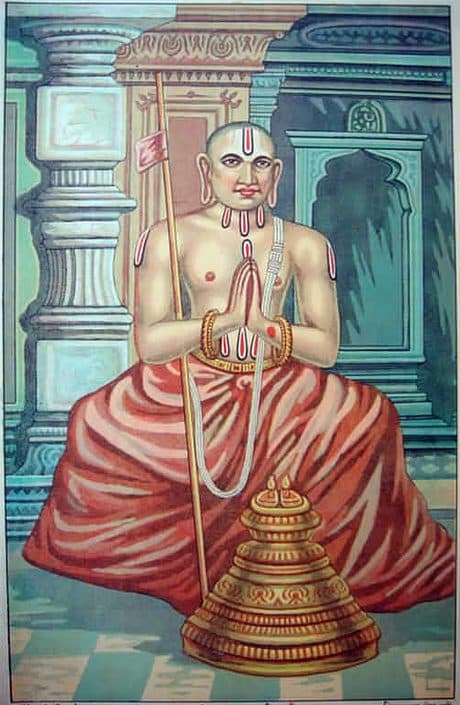
Rāmānuja · Viśiṣṭādvaita
English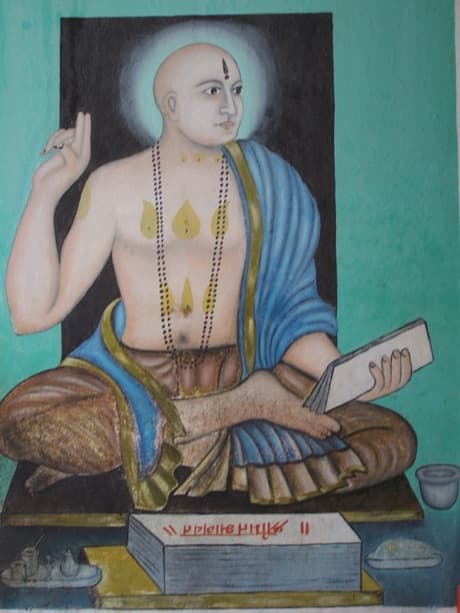
Madhvācārya · Dvaita
Madhva BhāṣyaSanskritEnglishOn verses 7.29–7.30
“जरामरणमोक्षाय इत्यन्यकामनिवृत्त्यर्थम् | मोक्षे सक्तिस्तुर्थं वा | न विधिः | मुमुक्षोरमुमुक्षास्तु वरो धेकान्तभक्तिभाक् इतीतरस्तुतेनारदीये || नात्मनिकम् || इति च |” - For deliverance from old age, death and for clarification of such other desires, clarification for deliverance is praiseworthy but not by way of prescription. Better than the aspirant (for deliverance) is the aspirant for the singular communion, thus, in Narada Puraana. Not merely for those who desire deliverance alone. “देवानां गुणलिङ्गानामानुश्राविककर्मणाम् | सत्व एवैकमनसो वृत्तिः स्वाभाविकी तु या | अनिमित्ता भगवति भक्तिः सिद्धेर्गीयसि | जरयत्याशु या कोशं निगीर्णनमलो यथा || इति भागवते लक्षणाच्च ||” - Devotion towards gods with neither distraction nor expectation of fruits in return but with concentrated mind, an attitude and with inherent nature and undistracted devotion to the Lord is established, which is superior, like the food in the stomach which is digested, thus pointing out the distinctive marks of भक्ति – communion in Bhagavat Puraana.
“आह च - सर्वे वेदास्तु देवार्था देवा नारायणार्थकाः | नारायणास्तु मोक्षार्थे मोक्षो नान्यार्थ ईष्यते | एवं मध्यमभक्तानामेकान्तानां न कस्यचित् | अर्थे नारायणो देवः सर्वमन्यत्तदर्थकम् || इति गीता कल्पे ||” - The knowledge of all the Vedas for the sake of the gods, the knowledge of all the (presiding) gods for the sake of Sriman Narayana, the knowledge of Sriman Narayana for the sake of deliverance, and deliverance for no other purpose at all, this for the intermediate devotees. But for the singularly committed ones, there exists nothing else but the Lord Narayana Himself, thus in Gita - Kalpa.
“ता एव च विदुः | यमवैष वृणुदे इति श्रुतेः || - they, the एकान्तिन, the singularly committed ones are aware. Only to such one (and according to his capacity and gradation) does He reveal His true form, thus in Katha Upanishad.
Madhvācārya · Dvaita
Gītā Tātparya NirṇayaSanskritEnglishOn verses 7.29–7.30
“तद् ब्रह्म इत्युक्तेऽन्यत्वशङ्कां निवारयति - साधिभूताधिदैवम् इति ||” - Brahman is to be consciously aware of, declaring thus he terminates all doubts about the supreme Lord of all creation.

Jñāneśvar · Vārkarī
English30 "Who know Me as the inner essence of the Elemental beings, and the inner essence of the Divine beings, and the inner entity of the Sacrifice: they, with the minds perfectly attuned, retain knowledge of Me even at the time of death." (180)
Those (seekers) are not distressed at the dissolution of body at death, who have, with self-realization that I am the inner essence mani- fested in the Elemental beings of cosmos,—come near Me, the inner essence of Divine beings, and who have, on the strength of their knowledge, begun to see in Me, the inner essence of the Sacrifice. Indeed are not even those beings, not due to die (yet), so painfully agitated and feel that the time of world-dissolution has arrived, at seeing the pangs of one about to have his life-cord snapped? It is not known how, yet those that have clung closely to Me, do not, even in the bustle of their departure (death) forget Me. Those that have reached perfection, should normally be taken as being the true Yogins, with their minds perfectly attuned. But while Lord Krishna was pouring out the juicy oration from the bottle in the form of these words, the cavity formed by joining the two palms (अजुली) in the form of Arjuna's attention did not move forward to receive it, since Arjuna's mind was still lingering behind on the preceding portion. As the fruit in the form of the word on Supreme Brahman overflowed with juice in the form of deep meaning, and spreading all around its fragrance in the form of good feelings, dropped down at the gentle breeze of grace, into the four mouthed-bag (खोळी) of Arjuna's ears, from the tree in the form of Lord Krishna's person, it was felt as if they (fruits) were formed out of great established eternal truths (सिद्धांत) or were dipped in the ocean of Supreme Divine Knowledge, or were rolled over and over again in the Supreme bliss. Their sweet charm made Arjuna's vision to take in gulps of nectar in the form of (pleasant) ecstatic wonder. As he enjoyed this taste of that Supreme happiness Arjuna even mocked and mouthed (वाकुलिया) at those enjoying Heavenly paradise, while his heart was suffused with great joy. Then Arjuna felt an intense longing for tasting the juice of the fruit in the form of divine words, since the beauty of the mere external vision of it made his happiness overflow itself. Therefore, hastily taking in the hand of his Intuition, the fruit in the form of Lord Krishna's words, he (Arjuna) put it at once into his mouth of inmost experience. But the tongue in the form of intellect could not relish it, while the teeth in the form of reason found it hard to crack it. At this, the husband of Subhadrā (Lord Krishna's sister) left off even sucking it. Getting surprised, he said to himself, 'Are these (merely) the glittering reflections in water of the stars? How have I got deceived by the external make-up of the syllables? What sort of letters are these? They appear to be mere folds of the sky; my intellect would not be able to get any trace of anything, were it even to take a jump however high. How would I be able to know anything about it, unless I get any trace of it?' With such thoughts Kirīti once again turned his eyes towards Lord Krishna, the Lord of Yadavas, and requested him, 'Oh God, these seven (Brahma, Karma, Adhyātma and others) words put together are untasted and unique. Otherwise, could these great truths have remained unsolved even after being heard with concentrated attention? But this is not a thing of that sort. Even surprise got greatly amazed seeing this string of words! I am startled and my mind is cut into two, no sooner than the rays of the words reached my heart through the windows of ears. I have a great liking for hearing the meaning, but there is no time even to speak that out. So God, proceed with the discourse immediately.' Just see, how adept is Arjuna in his way of asking questions viz. first making sure of the ground already covered and keeping his gaze further on the end and meanwhile mentioning also his great love for the theme; and never did he overstep the limits of scrupulous modesty. Otherwise, he would have outstretched his arms and held Lord Krishna in an embrace. Arjuna alone knew that that was the only respectful approach in putting questions to the Preceptor. Now the hearers should turn to the very charming manner, in which Samjaya will speak of Arjuna's question and Lord Krishna's reply to it. This will all be told, in simple, plain Marāthi so that the eyes have a vision of the meaning even before the ears grasp it. All the senses are lured by the beautiful shape of letters, even before the tongue of intellect tastes the sweet juice of meaning in the heart of the letters. Just see: not only that the buds of the flower-plant Mālati (मालती) please the nostrils with their fragrance, but the outward beauty of their colour does also please the eye. In that way the beauty of the Marāthi language blesses the senses with the power to make a conquest of Bliss and may then enter the dwelling place of eternal truths. Thus prays Jnānadev of Nivrittināth:— 'Do listen to my talk of beautiful words that silences all talk.' (210)
ज्ञानविज्ञानयोगो नाम सप्तमोऽध्यायः ॥ ७ ॥
Swami Ramsukhdas · Modern
English'Sādhibhūtādhidaivaṁ māṁ sādhiyajñaṁ ca ye viduḥ'—[Having described attributeless and formless God, in the preceding verse, He describes God, Who is endowed with attributes and form in this verse.]
Here 'Adhibhūta', stands for matter, which has predominance of Tamas (the mode of ignorance). This matter has no independent existence, of its own. It is transitory and kaleidoscopic. But, it seems real, pleasant and attractive, because of God, Who is real, pleasant and attractive. As ice has no existence without water, matter is nothing, but manifestation of God. This is knowledge about God and matter.
'Adhidaiva', is Brahmā, the creator of the world. He has predominance of 'rajogunā' (the mode of passion). The Lord, manifests Himself as Brahmā also. This is true knowledge about Adhidaiva and God.
'Adhiyajña' is Lord Viṣṇu, who pervades everywhere, in the form of unmanifest Divinity. In Him, there is predominance of the mode of goodness. This is true knowledge, about Adhiyajña and God.
Knowledge about God, with Adhibhūta, Adhidaiva and Adhiyajña is, that He stands holding the entire creation in one limb, (Gītā 10/42; 11/7) and in His supreme divine form, there are Adhibhūta (Infinite universes), Adhidaiva (Brahmā) and Adhiyajña (Viṣṇu) etc. Arjuna also says, 'O God, I behold in Your body, all the gods and multitudes of different beings, Brahmā, the Lord perched on a lotus, Lord Śiva and all the sages and celestial serpents' (Gītā 11/15). Thus, in reality, Lord Kṛṣṇa is Adhibhūta, Adhidaiva and Adhiyajña.
'Prayāṇakāle'pi ca mām te viduryuktacetasaḥ'—Steadfast in mind, are those, who remain equanimous in gain and loss, in prosperity and pleasures, and in becoming indifferent to the world, and are engrossed in worship of God. Such people, realize Him, at the time of death i.e., remain established in Him, even in the pangs of death, they do not lose heart in the least, in spite of great turmoil, in their physical and subtle bodies.
An Exceptional Fact About God's Entire Form
(1) All evils, are born, by accepting our affinity for matter and its evolutes—actions and things etc., and then those actions and things seem, to have their independent existence. But, if we by breaking up our affinity, for them get established in God, their assumed independent existence, merges into God.
In the world, we assume a thing or a person, as good or bad, but actually that thing or person, is nothing besides the manifestation of God. As far as decorum of caste, and Āśrama, (religious orders of different periods, of life), is concerned, we have to observe these in accordance with the ordinance of scriptures and great souls, because these are guides for attaining salvation.
There was existence of God, before this creation, and He
will exist after its dissolution. When a striver realizes this reality, about God, the universe merges into Him. It does not mean, that the creation perishes, but it means, that the striver does not attach importance to the world, which is an obstacle to salvation. As, in ornaments made of gold, there is nothing besides gold, a striver of steadfast mind realizes, that in the world there is nothing besides God. This fact has been explained, in the twenty-ninth and thirtieth verses.
(2) For the worship of God He is described in two ways—one with attributes and the second attributeless. The Lord, endowed with attributes is of two types—one endowed with attributes with form and the other endowed with attributes but formless. The attributeless Lord, is not of two types, He is only without attribute and formless. The formless Lord, is again of two kinds—one endowed with attributes, but formless and the other, attributeless and formless.
Devotees are of two types—one who worship God with attributes, and the other who worship God, without attributes. But both of them start their worship of the Lord, Who is endowed with attributes, but is formless. He assumes, that there is God, Who is the Supreme Lord and He is the most merciful, and the best one. Thus, though a devotee thinks of God, Who is attributeless and formless, yet with his intellect, he thinks of God, Who is endowed with attributes, and is formless.* The reason, is that intellect being the evolute of prakṛti (with attributes), cannot have access, to attributeless God.
* Adoration (Devotion) starts with God Who is endowed with attributes and is formless. So He has been described in that way in the twenty-eighth verse. Then in the twenty-ninth verse there is description of the Lord Who is attributeless and formless and in the thirtieth verse of One who is endowed with form and attributes. Thus each of them has been described in one verse. But in the eighth chapter each of the three types has been described in three verses eighth to tenth, eleventh to thirteenth and fourteenth to sixteenth respectively.
Worshippers, first worship God, Who is endowed with attributes and form. But so long as, His form is not fixed in their minds, they assume, 'God exists and He is ours.' The firmer His form gets fixed, the higher their adoration. In the end, when they are able to behold Him, talk to Him, touch Him and receive blessing from Him, their worship attains perfection.
Worshippers of attributeless God, think of Him, as One who pervades, everywhere. The subtler their disposition grows, the higher their worship, is. In the end when their attachment and egoism etc., are completely renounced, and no feeling of Tness or 'You'ness, is left and only pure consciousness remains, their worship attains, perfection.
Thus, both the devotees after attaining perfection, become one i.e., both of them attain the same Lord. The worshippers of the Lord, endowed with attributes and form by His grace, also realize the Lord, who is without attributes and form. If a striver, adoring attributeless and formless God, has some devotional influence, and wants to behold Him, he can do so. If the Lord wants to make him an instrument, for His mission, He reveals Himself to him, as He revealed Himself to Madhusūdanācārya.*
(3) The Lord, is endowed with attributes and He is also attributeless, according to the feelings of devotees. Similarly, He is endowed with form and is also formless. Not only this, He is also beyond the two. But this reality is known only, when a devotee realizes Him.
The Lord, Who pervades everywhere with His divine traits, such as beauty, love, glory, grace, etc., is called, God endowed with attributes. He is of two kinds—
* One shrewd fellow who is adored by the followers of non-dualistic discipline, who is authorized to sit on the throne of paradise and who runs after cowherdesses forcefully had made me a slave of his feet.
(i) Endowed with attributes and formless—Just like the sky of which attribute, is sound, but is formless, the Lord pervading the entire universe, is endowed with attributes and is formless.
(ii) Endowed with attributes and form—When the Lord, Who is with attributes and is formless, manifests Himself through His own divine potency, keeping His nature (prakṛti) under control, and is perceived by senses is called, the Lord endowed, with attributes and form.
When a striver assumes, that God does not possess divine traits, He is called the Lord, without attributes and form.
Attributes are also of two kinds (i) Uncommon divine traits, such as beauty, love, glory and grace etc., (ii) Three modes of nature—sattva (mode of goodness), raja (mode of passion) and tama (mode of ignorance). God may, either be endowed with attributes and be formless, or He may be endowed with attributes and form, He, is beyond the three modes of nature. He, by controlling His nature, plays the role of the Lord of creation, preservation and destruction of the universe, and yet remains totally free from the modes of nature (Gītā 7/13).
The Lord, Who is never bound by attributes, and has full command over them, is called, the Lord without attributes. Therefore, such a Lord, can be called endowed with attributes, as well as attributeless, as also endowed, with form and also formless. He has been described, in His entire form, in the twenty-ninth and thirtieth verses.
A special note on the chapter
In this chapter, Lord Kṛṣṇa first explained His changeable lower (insentient) nature, by 'aparā' and unchangeable higher (sentient) nature by 'parā' (7/4-5). Then He explained, that He is the origin and end of the whole universe. But, in the beginning
and in the end, only He exists (7/6-7). Then He explained, His comprehensiveness, by mentioning His seventeen divine manifestations, in the form of cause (7/8—12). Afterwards, He explained, that he, who is under delusion of three modes of nature i.e., who has accepted his affinity for the changing matter, cannot know Him, Who is beyond the modes of nature (7/13). In the fourteenth verse, He explained that His wonderful illusion, is extremely difficult to surmount. In the fifteenth verse, He explained, that evil doers do not seek refuge, in Him. In the sixteenth verse, He explained four types of virtuous men, who worship Him or take refuge in Him. Now a question arises, why Lord Kṛṣṇa has inserted the fifteenth verse, which seems to be out of context. The answer is, that had He not included the fifteenth verse, it would have remained to be said, 'Evil-doers do not seek refuge, in Me.'
There are two types of people, who take refuge in Him—first, those who regarding Him as God, take refuge in Him (7/16—19) and the second, those who regard Him as a common man worship, (take refuge in) other gods, in order to satisfy their desires (7/20—23). People worship, the gods for two reasons for their increased desires, and their failure to realize the greatness of God. Both of these, have been explained respectively, in (7/20—23) and (7/24). In the twenty-fifth verse, He has explained, that He is not manifest to those, who regard Him as an ordinary person. The twenty-fifth verse, seems to express that He is also veiled by divine potency. So, He has declared, in the twenty-sixth verse, that His knowledge is not veiled. People do not know Him, because of their attachment and aversion (7/27). But those, who are freed from delusion in the shape of pairs of opposites, worship Him with a firm resolve (7/28). Those who, taking refuge in Him, strive to know Him, in His entire form, at last attain Him (7/29-30).
If we delve deep into this chapter, we come to know, that there is description of inclination and disinclination for God. Those who have disinclination for God, and inclination for matter, follow the cycle of birth and death. But if they have inclination for God, they know the Lord who is endowed with attributes and is formless, who is attributeless and formless as also, who is endowed with attributes in entirety and attain Him.
**Appendix**—At the beginning of this chapter Lord Kṛṣṇa said to Arjuna, “I shall unfold to you this Jñāna with Vijñāna by which you will know Me fully, having known which nothing will remain to be known.” Then the Lord in the nineteenth verse having said ‘vāsudevaḥ sarvam’ described His full form in brief. Now at the end of the chapter the Lord gives the details of His full form.
A striver has taken birth, and a disease (suffering) is not inevitable. Therefore here the expression ‘jarāmaranamokṣāya’ means that the devotees, who take refuge in God, are delivered from old age and death viz., they are not sad by thinking of their old age and they are not sad by thinking of the end, they will meet after death. They, having taken shelter in God, strive; therefore they know God in full with parā prakṛti and aparā prakṛti viz., know Jñāna with Vijñāna.
Though a Karmayogī and a Jñānayogī are also liberated from birth and death but a devotee besides being liberated from birth and death, knows God in His entire form. The reason is that a Karmayogī and a Jñānayogī attain equanimity by practising the discipline of action and the discipline of knowledge respectively from the beginning, but a devotee depends on God from the beginning. As he depends on God, the Lord by showering His grace, enables him to know Him in full.
In the third verse of this chapter the Lord declared, “One
who knows Me fully is rare—'kaścinmāṃ vetti tattvataḥ'. Here He explains, 'He who takes refuge in Me, knows Me in My entire form.' Therefore the main spiritual practice to know God in full (Jñāna with Vijñāna) is—surrender in God (māmāśritya). The reason is that God in full is not known by reflection but He is known by His grace, when a devotee with faith and belief takes shelter in Him. Therefore the Lord at the beginning used the term 'madāśrayaḥ' and in the end concludes this chapter by using the term, 'māmāśritya'.
'Brahma' (attributeless- formless), 'kṛtsna adhyātma' (endless souls of endless births) and 'akhila karma' (all the actions of origin-midstate-end etc.)—this is the sphere of knowledge. In this sphere there is predominance of nirguṇa (attributeless) Brahma. 'Adhibhūta' (the entire universe consisting of five subtle elements including the body), 'adhidaiva' (all the deities such as Brahmā etc., with the presiding deities of mind-senses) and adhiyajña (immanent Lord Viṣṇu and all His forms)— this is the sphere of 'vijñāna'. In this division there is predominance of Saguṇa (endowed with attributes) God.
God with 'adhibhūta', 'adhidaiva' and 'adhiyajña' means that the 'Sat', 'Asat', 'parā-aparā'—all is God. There is nothing else besides God. If the real and the unreal are distinguished, it is the path of knowledge—'nāsato vidyate bhāvo, nābhāvo vidyate sataḥ, ubhayorapi...' (Gītā 2/16) and if they are unified, it is the path of devotion—'Śadasaccāhamarjuna' (Gītā 9/19).
There is description of 'Brahma' from the thirteenth verse to the twenty-sixth verse of the fifth chapter. 'Kṛtsna adhyātma' has been mentioned in the twenty-ninth verse of the sixth chapter by the expression 'Sarvabhūtasthamātmānam'. 'Akhila Karma' has been described in the eighteenth, twenty-third and thirty-third verses of the fourth chapter by the expression 'kṛtsna karmakṛt', 'karma samagram' and 'sarvaṃ karmākhilaṃ' respectively.
An action ends but the self and Brahma are never non-existent. In jurisprudence it is mentioned that the sense which perceives the existence of a thing, the same sense perceives the non-existence and also the class of that thing. Therefore the knowledge which enables a man to know actions (karma cākhilam), with the same knowledge, he knows the nothingness of actions viz., inaction—'karmanyakarma yaḥ paśyet (Gītā 4/18). Brahma (the Absolute), ātmā (the soul) and akarma (inaction)—the three are only one; this knowledge is the meaning of the expression—'te brahma tadviduḥ kṛtsnamadhyātmaṃ karma cākhilam.'
An 'action' is limited, 'adhyātma' (self) is more extensive than 'action', 'Brahma' is more extensive than 'adhyātma'. But 'mām' (God in full) is superior even to Brahma because within 'Brahma' 'the entire form of God' is not included but within 'the entire form of God' Brahma is included.
The purpose of using the term 'kṛtsna' with adhyātma' is the aggregate of individual self, seen in different forms whom the Lord has called His 'parā prakṛti'. The Lord by giving the word 'akhila' with 'karma' means—all the virtuous and sinful actions, whose fruit leads the self to numerous wombs and numerous worlds; but the term 'kṛtsna' or 'akhila' has not been used with 'Brahma', it means that 'Brahma' is not numerous but is only one.
In the Gītā the Lord has mentioned two-fold path to achieve equanimity—Karmayoga and jñānayoga. The two paths are worldly—'loke'smindvividhā niṣṭhā' (Gītā 3/3); but Bhaktiyoga is 'alaukika niṣṭhā' (unworldly path). The reason is that in Karmayoga there is predominance of 'kṣara' (world) and in Jñānayoga there is predominance of 'akṣara' (soul). Kṣara and akṣara—both are in the world—'dvāvimau puruṣau loke kṣaraścākṣara eva ca' (Gītā 15/16), therefore Karmayoga and
Jñānayoga—both are worldly paths. But in Bhaktiyoga there in predominance of God Who transcends the perishable (Kṣara) and is superior to the imperishable (akṣara) (Gītā 15/17-18). Therefore Bhaktiyoga is the unworldly path. In the entire form of God, there is mention of Brahma, adhyātma and Karma—in them there is mention of the worldly path (Karmayoga and Jñānayoga)* and in 'adhibhūta, adhidaiva and adhiyajña there is mention of the unworldly path (Bhaktiyoga). 'Jñāna (knowledge) is worldly—'na hi jñānena sadṛśam pavitramiha† vidyate' (Gītā 4/38) and Vijñāna is unworldly. The worldly and the unworldly—both are the manifestations of 'Samagra' (full form of) God—'Vāsudevaḥ Sarvam'.
In the term 'loka' both insentient and sentient are included. The term 'loka' cannot denote either only insentient or only sentient. Therefore in 'laukika' both insentient and sentient are included but in 'alaukika' only sentient is included because 'alaukika' is ever divine. But in 'the entire form' (Samagra), 'laukika' (worldly) and 'alaukika' (unworldly)—both are included.
Here a point needs special attention that 'Brahma' Who is attributeless and formless is within the entire form of God. Generally people believe that within attributeless and formless Brahma, there is God endowed with attributes. They hold that Brahma is free from māyā and God is not free from Māyā. In fact this assumption is neither in accordance with the ordinance
* The term 'adhyātma' should mean 'Jñānayoga; and 'Karma' should mean 'Karmayoga'. Brahma is attained by both Jñānayoga and Karmayoga (Gītā 5/4-5).
Being the context of devotion, the Lord here has not described Jñānayoga and Karmayoga in detail. They have already been described in detail from the second to the sixth Chapter.
† Here the term 'iha' used within 'pavitramiha' stands for 'loka' (world).
of the scriptures nor is reasonable because when, in Brahma, there is no illusion (māyā) then how can God with 'māyā' be within Brahma? How is there 'māyā' in Brahma? But in the Gītā the Lord declares, 'In a fragment of My entire form there is Brahma because I am the support of Brahma 'brahmaṇo hi pratiṣṭhāham' (Gītā 14/27) and this universe is pervaded by Me in My unmanifest form 'mayā tatamidaṁ sarvaṁ jagadavyaktamūrtinā' (9/4).' By these utterances the Lord means to say, 'I am not a fragment of Brahma but Brahma is My fragment.' Therefore if we reflect upon it in an impartial manner, it is evident that in the Gītā there is not predominance of Brahma but there is predominance of God. The entire form of God is complete within which God with attributes as well as attributeless; God with form and also formless are included.
In fact the entire form can be of God endowed with attributes only because within the word 'saguṇa' (God endowed with attributes), 'nirguṇa' (attributeless) (the Absolute) can be included, but within the word 'nirguṇa', 'saguṇa' cannot be included. The reason is that in 'saguṇa' there is no negation of 'nirguṇa' but in 'nirguṇa' there is negation of 'guṇas' (attributes). Therefore in 'nirguṇa' the word 'samagra' (full or entire) cannot be used. So here with 'adhyātma' and Karma' the words 'kṛtsna' and 'akhila' have been used respectively but no such word has been used with Brahma. Therefore there is entirety (fullness) in God endowed with attributes rather than in attributeless Brahma.
**Question**—How are Brahma, adhyātma and Karma all the three 'laukika (worldly)?
**Answer**—The Lord has called Brahma 'akṣara' (imperishable)—'akṣaraṁ brahma paramam' (Gītā 8/3) and He has also called the soul 'akṣara'—'dvāvimau puruṣau loke kṣaraścākṣara eva
ca' (Gītā 15/16). The soul and Brahma—both are one—'ayamātmā brahma' (Māṇḍūkya 1). The soul which by having connection with Prakṛti (body) is called 'jīva' (adhyātma) (embodied soul),* the same by having no connection with Prakṛti is Brahma'. Therefore according to the Gītā as 'jīva' is in the world, so is 'Brahma' in the world viz., Brahma is attained by the worldly paths (Karmayoga and Jñānayoga).
'Adhyātma viz., the soul has sustained the world 'yayedam dhāryate jagat' (Gītā 7/5). The soul has no independent existence of its own. Therefore the soul by being attached to the world has become 'jagat' (worldly) (Gītā 7/13). Being in the world the soul is also 'laukika' (worldly)—'mamaivāṁśo jīvaloke' (Gītā 15/7), 'dvāvimau puruṣau loke ksaraścākṣara eva ca' (Gītā 15/16).
Actions are performed in two ways with an interested motive and in a disinterested manner. These two types of actions being in the world are laukika†.
**Question:**—How are 'adhibhūta', 'adhidaiva' and 'adhiyajña'—these three unworldly?
**Answer:**—'adhibhūta' viz., the entire world consisting of the five subtle elements, being the manifestation of God is unworldly—'amṛtam caiva mṛtyuśca sadasaccāhamarjuna' (Gītā 9/19) 'I am immortality as well as death; I am also being
* bādhyo biṣaya saneha te, tāte kahiyai jīva
† In the world, actions performed with an interested motive—
'yajñārthātkarmaṇo' nyatra loko' yam karmabandhanah' (Gītā 3/9); 'kṣipraṇhi mānuṣe loke siddhirbhavati karmajā' (Gītā 4/12); 'Karmānubandhīni manuṣyaloke' (Gītā 15/2). In the world actions performed in a disinterested manner 'loke' smin-dvividhā...yoginām' (Gītā 3/3).
In fact actions are neither 'Sakāma' nor 'Niṣkāma' but the doer is 'Sakāma' or 'Niṣkāma.' Therefore 'sakāma (interested motive) and 'niṣkāma' (disinterested manner) persist in the doer.
and non-being, both*. The cosmic form which Lord Kṛṣṇa revealed to Arjuna was also divine or unworldly†.
The Lord revealed His divine cosmic form in a part of His divine body‡. Therefore the world consisting of five subtle elements, being the cosmic form of God, is also unworldly§. The Lord has also called His 'vibhūtis' (divine glories) as divine viz., unworldly—'divyā hyātmavibhūtayaḥ'
* manasā vacasā dṛṣṭyā gṛhyate'nyairapīndriyaiḥ ahameva na matto'nyaditi budhyadhva mañjasā
(Śrīmadbhā. 11/13/24)
Whatever is perceived (received) with the mind, with tongue, with eyes and with other senses, all that is only 'I'. Therefore there is nothing else besides Me—understand and accept this principle quickly after reflecting upon it.
† 'nānāvidhāni divyāni (Gītā 11/5), 'anekadivyābharanam divyāne-kodyatāyudham' (11/10), 'divyamālyāmbaradharam divyagandhānulepanam' (11/11); 'paśyāmi devāṁstava deva dehe...sarvānuragāṁsca divyān. (11/15)
‡ The Lord declares—'ihaikastham jagatkṛtsnam...mama dehe' (11/7).
Sañjaya utters—'tatraikastham jagatkṛtsnam...apaśyaddevadevasya śarīre' (11/13).
Arjuna makes an utterance—'paśyāmi devāṁstava deva dehe' (11/15).
§ khaṁ vāyumagnim salilam mahīm ca jyotīnṣi sattvāni diśo drumādīn. saritsamudrāṁsca hareḥ śarīram yat kiñca bhūtam praṇamedananyah.
(Śrīmadbhā. 11/2/41)
Ether, air, fire, water, earth, planet, constellation, beings, animals, directions, trees, rivers, oceans—all are the bodies of God, by assuming this, a devotee bows to all with exclusive devotion.
bhūdvīpavarṣasaridadrinabhaḥ samudrapātāladinnarakabhāgaṇalokasansthā gītā mayā tava nṛpādbhutamiśvarasya sthūlam vapuḥ sakalajīva nikāya dhāma
(Śrīmadbhā. 5/26/40)
'O Parīkṣit! I have described to you the earth and within it—islands, varṣa (tracts), rivers, mountains, sky, oceans, netherworld, directions, hells, constellation and the situation of different worlds—this is God's very wonderful gross form which is the refuge of all the groups of beings.
(Gītā 10/19), 'mama divyānām vibhūtīnām' (10/40)* But a person (embodied soul) out of ignorance with his intellect (because of attachment-aversion) perceives this 'jagata' (world) as 'laukika' (mundane) (matter). Therefore when ignorance is wiped out, inertness (matter) does not persist, only divinity remains.
'adhidaiva' viz., Brahmā etc., all the deities are unworldly, 'adhiyajña' viz., indwelling God in spite of lodging in the hearts of all, because of remaining untainted, is unworldly†.
In the expression 'Sādhibhūtādhidaivam māṁ Sādhiyajñam' the Lord mentions, 'He who knows Me with adhibhūta, adhidaiva and adhiyajña,' it proves that as these three are with God so they are unworldly, otherwise they are worldly. So long as there is no connection with God, all is worldly; when there is connection with God, all becomes unworldly. Therefore Karmayoga and Jñānayoga are 'worldly paths' as in them a striver's effort is important while 'Bhaktiyoga' is the unworldly path as in it there is predominance of refuge in God.
In fact there is no entity which is worldly. The real entity is only unworldly. But from the view-point of a striver the discrimination between the worldly and the unworldly has been mentioned. It means that this distinction between the worldly and the unworldly persists out of ignorance because of attachment and aversion. If attachment and aversion are
* Arjuna has also called 'vibhūtis' (glories) as divine—'vaktumarhasya-śeṣeṇa divyā hyātmavibhūtayāḥ' (10/16).
† dvā suparnā sayujā sakhāyā samānam vṛkṣam pariṣasvajāte tayoranyāṁ pippalam svādvattyanaśnannanyo abhicākasīti
(Muṇḍaka 3/1/1; Śvetāśvatara 4/6)
Two birds—soul and God who keep company with each other and are friendly with each other, live by taking refuge in the same tree—body. One of them the soul (embodied soul) tasting the fruit of actions of that tree relishes (enjoys) them but the other (God) without relishing them only illumines them.
renounced, all is unworldly, spiritual and divine—'vāsudevaḥ sarvam'. The reason is that the mundane has no independent existence. It is because of attachment and aversion that the mundane seems to exist and is valued. It is because of attachment and aversion that a man (the self) has made the world, which is the manifestation of God, mundane and he himself has also become mundane.
The purpose of describing knowledge with 'Vijñāna' viz., the entire form of God is that non-self-self, the real-unreal, parā-aparā (higher and lower nature), kṣetra (it is constituted of 24 elements)—kṣetrajña (soul)—whatever persists is only God's manifestation. Therefore the Lord here at the beginning and at the end of the description of His entire form has used the term 'mām' (Me) which denotes His entire form—'māmāśritya' (7/29) and 'mām te viduḥ' (7/30).
The Lord has declared that the nature of actions is mysterious—'gahanā karmaṇo gatiḥ' (Gītā 4/17), but a devotee knows it also. Inaction in action and action in inaction (4/18)—a devotee knows these two also. It means that he knows actions and also the Discipline of Action (Karmayoga). A Karmayogī knows only Karmayoga; a Jñānayogī knows only Jñānayoga; but a devotee by God's grace knows both—Karmayoga and Jñānayoga.
The idea expressed in the first verse of this chapter by the expression 'yogaṁ yuñjanmadāśrayaḥ' has been expressed here by the expression 'māmāśritya yatanti ye'; and the idea expressed by the expression 'mayyāsaktamaṇāḥ' has been expressed here by the expression 'yuktacetasaḥ'. It means, 'The devotee who takes shelter in Me attains the aim which is attained by Karmayoga and Jñānayoga viz., they know Brahma Who is the fruit (aim) of these two disciplines—'te brahma tadviduḥ' and they also know God in full—'mām te viduḥ'.
In the expression ‘prayāṇakāle’pi’ the term ‘api’ means that those devotees know God before the hour of death and also at the hour of death viz., their knowledge never disappears. Such devotees become ‘yuktacetā (steadfast in mind) viz., their mind has no independent existence, it gets identified with God, only God remains. Being one (having eternal union) with God, they are neither separated from God nor is God separated from them. Such devotees at the time of death, even if some thought comes to their mind, they don’t meet the fate of ‘yogabhrāṣṭa’ (he who deviates from yoga) but attain God—‘prayāṇakāle’pi ca mām te viduryuktacetasaḥ’. The reason is that from the view-point of those devotees, there is nothing else besides God, then where will their mind wander besides God? Why will it wander? How will it wander? If he thinks of anything, he will think of God only, then how will his mind deviate and without deviation of the mind, how will he fall from yoga? The reason is that in the discipline dependant on instruments (Karaṇa sāpekṣa), when the mind deviates from Yoga, then there is fall from Yoga—‘yogāccalitamānasaḥ’ (Gītā 6/37) but he, who beholds God everywhere, has his eternal union with God.
Some devotees want only emancipation (Salvation)—‘jarāmaranamokṣāya’ and some devotees want love (devotion)—‘mām te viduryuktacetasaḥ’. The devotees who want salvation, they know Karmayoga and Jñānayoga (brahma, adhyātma and Karma) but the devotees who want love, they themselves, know God in full—‘mām viduḥ’. God confers his devout devotees with Karmayoga (buddhiyoga) and Jñānayoga—both (Gītā 10/10-11). Bondage in the form of old age and death; and also salvation—both are worldly but love (devotion) is unworldly. Though devotion as spiritual-discipline is worldly but the aim being unworldly, that devotion is included in
unworldly 'Sādhya bhakti' (devotion as an end)—'bhaktyā sañjātayā bhaktyā' (Śrīmadbhā. 11/3/31).
ॐ तत्सदिति श्रीमद्भगवद्गीतासूपनिषत्सु ब्रह्मविद्यायां योगशास्त्रे

Ādi Śaṅkarācārya · Advaita
Sanskritसाधिभूताधिदैवं अधिभूतं च अधिदैवं च अधिभूताधिदैवम्, सह अधिभूताधिदैवेन वर्तते इति साधिभूताधिदैवं च मां ये विदुः, साधियज्ञं च सह अधियज्ञेन साधियज्ञं ये विदुः, प्रयाणकाले मरणकाले अपि च मां ते विदुः युक्तचेतसः समाहितचित्ता इति ॥
Ādi Śaṅkarācārya · Advaita
Hindi(इसी प्रकार) जो मनुष्य मुझ परमेश्वरको साधिभूताधिदैव अर्थात् अधिभूत और अधिदैवके सहित जानते हैं एवं साधियज्ञ अर्थात् अधियज्ञके सहित भी जानते हैं वे निरुद्ध-चित्त योगी लोग मरण- कालमें भी मुझे यथावत् जानते हैं
Jñāneśvar · Vārkarī
Hindi(7.180) जिन्होंने मुझ पंचभूतात्मक साकार को अनुभवरूपी हाथों से पकड़कर अधिदैव जीवात्मा को स्पर्श किया है,
(7.181) जिनको ज्ञानशक्ति के बल से मैं अधियज्ञ परमात्मा दिखाई देता हूँ, वे शरीर के वियोग से विरही नहीं होते। (7.182) यों तो आयुष्य की डोरी टूटते समय प्राणियों को जो व्याकुलता होती है, उसे देख न मरनेवालों के चित्त में भी क्या प्रलय नहीं हो जाता?
(7.183) परन्तु जो मेरे स्वरूप को पहुँच गये हैं वे देहान्त की व्याकुलता के समय भी, न जाने क्यों, मुझे नहीं भूलते।
(7.184) सामान्यतः यही समझो कि जो ऐसे निपुण हैं वही अन्तःकरणयुक्त योगी हैं।
(7.185) इस शब्दरूपी गंगाजली के नीचे अर्जुन को अवधान की अंजलि न बताई गई। क्योंकि वह उस समय क्षणभर कुछ और सोच रहा था।
(7.186) वे ब्रह्मप्रतिपादक वचनरूपी फल नाना अर्थरूपी रस से भरे हुए थे और भावरूपी सुगन्ध से महक रहे थे।
(7.187) ऐसे वे श्रीकृष्णरूपी वृक्ष के वचनफल जब सहजकृपारूपी मन्द वायु के झकोरे से अर्जुन के श्रवणरूपी पल्ले में अकस्मात् जा पड़े
(7.188) तो ऐसे दिखाई दिये कि मानों सिद्धान्त के ही बने हुए हों, अथवा ब्रह्मरस के समुद्र में डूबाये हुए हों और परमानन्द में धुले हुए हों। (7.189) ऐसी निर्मल सुन्दरता देखकर अर्जुन के ज्ञान-क्षेत्र विस्मयरूपी अमृत के घूँट लेने लगे।
(7.190) ऐसी सुख-सम्पत्ति प्राप्त होते ही वह स्वर्ग को भी विराने लगा और उसके हृदय में गुदगुदी होने लगी।
(7.191) इस प्रकार जब ऊपर की उत्तमता से सुख बढ़ने लगा तब उसे रस का स्वाद लेने की इच्छा हुई।
(7.192) जल्दी से उसने उन वचनफलों को अनुमानरूपी हथेली पर लेकर एकदम अनुभवरूपी मुख में डालना चाहा।
(7.193) परन्तु जब सुभद्रापति अर्जुन ने देखा कि वे फल न तो विचाररूपी रसना से दबते हैं और न हेतुरूपी दाँतों से टूटते हैं तब उसने उन्हें मुँह से न लगाया।
(7.194) वह आश्चर्ययुक्त हो कहने लगा कि ये तो जल में दीखनेहारे तारागण हैं। इन अक्षरों की सुगमता से मैं कैसा फँसा!
(7.195) ये वास्तव में शब्द नहीं, आकाश के परत हैं। यहाँ हमारी मति डूबे तो भी थाह न लगे।
(7.196) तो फिर और कहीं से जानने की बात ही क्या है? इस प्रकार जी में सोच कर अर्जुन ने फिर से श्रीकृष्ण की ओर दृष्टि की; (7.197) और विनती की कि अजी, ये सातों ही शब्द अनास्वादित हैं, यह बड़ा अचरज है।
(7.198) यो तो अवधान की तीव्रता रहे तो अनेक सिद्धान्तों के अनुभव क्या श्रवण के ही बल से ज्ञात हुए बिना रह सकते हैं?
(7.199) परन्तु सम्प्रति हे देव! मेरा हाल वैसा नहीं हुआ। मैंने अक्षरों का समुदाय देखा और मेरे विस्मय के जी में भी विस्मय हुआ।
(7.200) कान के झरोखे में से आपके शब्दरूपी किरण हृदय में प्रकाशने नहीं पाये कि चमत्कार से मेरा अवधान बन्द हो गया
(7.201) और अब मुझे इन शब्दों का अर्थ जानने की इच्छा हुई है। यह कहने में समय व्यतीत करना भी मैं सह नहीं सकता। इसलिए हे देव! जल्दी से निरूपण कीजिए।
(7.202) इस प्रकार पिछली समालोचना कर अगले अभिप्राय की ओर दृष्टि देकर तथा बीच में अपनी इच्छा प्रदर्शित कर,
(7.203) (पूछने की कुशलता देखिए कि) अर्जुन मर्यादा का सीमा उल्लंघन नहीं होने देता, तथापि श्रीकृष्ण के हृदय को आलिंगन देने की चेष्टा कर रहा है। (7.204) अजी, श्रीगुरु से जब प्रश्न किया जाय तब कैसा सावधान रहना चाहिए, इसका सम्पूर्ण मर्म एक अर्जुन ही जानता है।
(7.205) अब उसका प्रश्न और उस पर सर्वज्ञ श्रीहरि का उत्तर संजय कैसे प्रेम से वर्णन करेंगे!
(7.206) उस कथा का ठेठ भाषा में वर्णन होगा। उस पर ध्यान दीजिए। जैसे कानों के पूर्व दृष्टि को ही लाभ होता है,
(7.207) जैसे बुद्धि की जिह्वा से शब्दों का सार चखने के पहले ही अक्षरों की शोभा इन्द्रियों को मोह लेती है,
(7.208) देखो, घ्राणेन्द्रिय मालती की कलियों को उसकी सुगन्धि लेकर पहचानती है परन्तु नेत्र क्या उसकी ऊपरी शोभा से पहले ही सुखी नहीं हो जाते?
(7.209) वैसे ही इस भाषा की शोभा से इन्द्रियाँ मानों राज्य करेंगी और फिर धीरे से सिद्धान्तरूपी नगर प्राप्त करेंगी।
(7.210) ऐसे उत्तम और अनिर्वचनीय वचन सुनिए। मैं श्रीनिवृत्ति का दास ज्ञानदेव निवेदन करता हूँ।
इति श्रीज्ञानदेवकृत भावार्थदीपिकायां सप्तमोऽध्यायः।
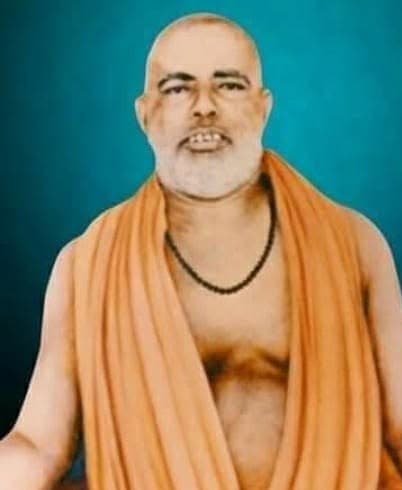
Sri Udiya Baba · Modern
Hindiसंगति— भक्तों को भगवान् के सिवा और कुछ जानने की इच्छा नहीं होती—यह बात अगले श्लोक में बतायी जाती है—
भावार्थ— जो लोग अधिभूत, अधिदैव और अधियज्ञ के सहित मुझे जानते हैं, निरन्तर संयत-चित्त रहने के कारण वे प्रयाणकाल में भी मुझे जान ही लेते हैं।
व्याख्या— जानना दो प्रकार का है। पहला स्वरूप को जानना और दूसरा सगुण-साकार रूप को जानना। इस श्लोक के पहले चरण में जो 'माम्' शब्द है वह स्व-स्वरूप की ओर संकेत करता है तथा दूसरा 'माम्' सगुण स्वरूप भगवान् का वाचक है। जो अधिभूत, अधिदैव और अध्यात्म को, तीनों गुणों को, तीनों कालों को तथा जाग्रदादि तीनों अवस्थाओं को अर्थात् सम्पूर्ण त्रिपुटियों को ब्रह्मस्वरूप देखते हैं, वे ही अन्त-काल में ऐसा अनुभव करते हैं कि सम्पूर्ण दृश्य मैं ही हूँ। वे ही युक्तचित्त हैं। यह पहले 'माम्' का अर्थ है। दूसरे 'माम्' का अर्थ स्वयं भगवान् कृष्ण है। इसका तात्पर्य यह है कि जो श्रीकृष्ण को भजते हैं उन्हें ऐसा अनुभव होता है कि सब कुछ मैं ही हूँ। अथवा अधिभूत, अधिदैव और अधियज्ञ मैं हूँ—यह पहले 'माम्' का अर्थ है तथा सम्पूर्ण दृश्य मैं हूँ—यह दूसरे 'माम्' का अर्थ है।
Swami Ramsukhdas · Modern
Hindi'साधिभूताधिदैवं मां साधियज्ञं च ये विदुः'—[पूर्वश्लोकमें निर्गुण-निराकारको जाननेका वर्णन करके अब सगुण-साकारको जाननेकी बात कहते हैं।]
यहाँ 'अधिभूत' नाम भौतिक स्थूल सृष्टिका है, जिसमें तमोगुणकी प्रधानता है। जितनी भी भौतिक सृष्टि है, उसकी स्वतन्त्र सत्ता नहीं है। उसका क्षणमात्र भी स्थायित्व नहीं है। फिर भी यह भौतिक सृष्टि सत्य दीखती है अर्थात् इसमें सत्यता, स्थिरता, सुखरूपता, श्रेष्ठता और आकर्षण दीखता है। यह सत्यता आदि सब-के-सब वास्तवमें भगवान्के ही हैं, क्षणभंगुर संसारके नहीं। तात्पर्य है कि जैसे बर्फकी सत्ता जलके बिना नहीं हो सकती, ऐसे ही भौतिक स्थूल सृष्टि अर्थात् अधिभूतकी सत्ता भगवान्के बिना नहीं हो सकती। इस प्रकार तत्त्वसे यह संसार भगवत्स्वरूप ही है—ऐसा जानना ही अधिभूतके सहित भगवान्को जानना है।
'अधिदैव' नाम सृष्टिकी रचना करनेवाले हिरण्यगर्भ ब्रह्माजीका है, जिनमें रजोगुणकी प्रधानता है। भगवान् ही ब्रह्माजीके रूपमें प्रकट होते हैं अर्थात् तत्त्वसे ब्रह्माजी भगवत्स्वरूप ही हैं—ऐसा जानना ही अधिदैवके सहित भगवान्को जानना है।
'अधियज्ञ' नाम भगवान् विष्णुका है, जो अन्तर्यामी-रूपसे सबमें व्याप्त हैं और जिनमें सत्त्वगुणकी प्रधानता है। तत्त्वसे भगवान् ही अन्तर्यामीरूपसे सबमें परिपूर्ण हैं—ऐसा जानना ही अधियज्ञके सहित भगवान्को जानना है।
अधिभूत, अधिदैव और अधियज्ञके सहित भगवान्को जाननेका तात्पर्य है कि भगवान् श्रीकृष्णके शरीरके किसी
एक अंशमें विराट् रूप है (गीता—दसवें अध्यायका बयालीसवाँ और ग्यारहवें अध्यायका सातवाँ श्लोक) और उस विराट् रूपमें अधिभूत (अनन्त ब्रह्माण्ड), अधिदैव (ब्रह्माजी) और अधियज्ञ (विष्णु) आदि सभी हैं, जैसा कि अर्जुनने कहा है—हे देव! मैं आपके शरीरमें सम्पूर्ण प्राणियोंको; जिनकी नाभिसे कमल निकला है, उन विष्णुको, कमलपर विराजमान ब्रह्माको और शंकर आदिको देख रहा हूँ (गीता—ग्यारहवें अध्यायका पन्द्रहवाँ श्लोक)। अतः तत्त्वसे अधिभूत, अधिदैव और अधियज्ञ भगवान् श्रीकृष्ण ही हैं। श्रीकृष्ण ही समग्र भगवान् हैं।
'प्रयाणकालेऽपि च मां ते विदुर्मुक्तचेतसः'—जो संसारके भोगों और संग्रहकी प्राप्ति-अप्राप्तिमें समान रहनेवाले हैं तथा संसारसे सर्वथा उपरत होकर भगवान्में लगे हुए हैं, वे पुरुष युक्तचेता हैं। ऐसे युक्तचेता मनुष्य अन्तकालमें भी मेरेको ही जानते हैं अर्थात् अन्तकालकी पीड़ा आदिमें भी वे मेरेमें ही अटलरूपसे स्थित रहते हैं। उनकी ऐसी दृढ़ स्थिति होती है कि वे स्थूल और सूक्ष्म-शरीरमें कितनी ही हलचल होनेपर भी कभी किंचिन्मात्र भी विचलित नहीं होते।
भगवान्के समग्ररूप-सम्बन्धी विशेष बात
(१)
प्रकृति और प्रकृतिके कार्य—क्रिया, पदार्थ आदिके साथ अपना सम्बन्ध माननेसे ही सभी विकार पैदा होते हैं और उन क्रिया, पदार्थ आदिकी प्रकटरूपसे सत्ता दीखने लग जाती है। परन्तु प्रकृति और प्रकृतिके कार्यसे सर्वथा
सम्बन्ध-विच्छेद करके भगवत्स्वरूपमें स्थित होनेसे उनकी स्वतन्त्र सत्ता उस भगवतत्त्वमें ही लीन हो जाती है। फिर उनकी कोई स्वतन्त्र सत्ता नहीं दीखती।
जैसे, किसी व्यक्तिके विषयमें हमारी जो अच्छे और बुरेकी मान्यता है, वह मान्यता हमारी ही की हुई है। तत्त्वसे तो वह व्यक्ति भगवान्का स्वरूप है अर्थात् उस व्यक्तिमें तत्त्वके सिवाय दूसरा कोई स्वतन्त्र व्यक्तित्व ही नहीं है। ऐसे ही संसारमें 'यह ठीक है, यह बेठीक है' इस प्रकार ठीक-बेठीककी मान्यता हमारी ही की हुई है। तत्त्वसे तो संसार भगवान्का स्वरूप ही है। हाँ, संसारमें जो वर्ण-आश्रमकी मर्यादा है, 'ऐसा काम करना चाहिये और ऐसा नहीं करना चाहिये'—यह जो विधि-निषेधकी मर्यादा है, इसको महापुरुषोंने जीवोंके कल्याणार्थ व्यवहारके लिये मान्यता दी है।
जब यह भौतिक सृष्टि नहीं थी, तब भी भगवान् थे और इसके लीन होनेपर भी भगवान् रहेंगे—इस तरहसे जब वास्तविक भगवतत्त्वका बोध हो जाता है, तब भौतिक सृष्टिकी सत्ता भगवान्में ही लीन हो जाती है अर्थात् इस सृष्टिकी स्वतन्त्र सत्ता नहीं रहती। इसका यह तात्पर्य नहीं है कि संसारकी स्वतन्त्र सत्ता न रहनेपर संसार मिट जाता है, उसका अभाव हो जाता है, प्रत्युत अन्तःकरणमें सत्यत्वेन जो संसारकी सत्ता और महत्ता बैठी हुई थी, जो कि जीवके कल्याणमें बाधक थी, वह नहीं रहती। जैसे सोनेके गहनोंकी अनेक तरहकी आकृति और अलग-अलग उपयोग होनेपर भी उन सबमें एक ही सोना है, ऐसे ही भगवद्भक्तके द्वारा अनेक तरहका यथायोग्य सांसारिक व्यवहार होनेपर भी उन सबमें एक ही भगवतत्त्व है—ऐसी अटलबुद्धि रहती है। इस तत्त्वको समझनेके लिये ही उन्तीसवें और तीसवें श्लोकमें समग्ररूपका वर्णन हुआ है।
(२)
उपासनाकी दृष्टिसे भगवान्के प्रायः दो रूपोंका विशेष वर्णन आता है—एक सगुण और एक निर्गुण। इनमें
सगुणके दो भेद होते हैं—एक सगुण-साकार और एक सगुण-निराकार। परन्तु निर्गुणके दो भेद नहीं होते, निर्गुण निराकार ही होता है। हाँ, निराकारके दो भेद होते हैं—एक सगुण-निराकार और एक निर्गुण-निराकार।
उपासना करनेवाले दो रुचिके होते हैं—एक सगुण-विषयक रुचिवाला होता है और एक निर्गुणविषयक रुचिवाला होता है। परन्तु इन दोनोंकी उपासना भगवान्के 'सगुण-निराकार' रूपसे ही शुरू होती है; जैसे—परमात्म-प्राप्तिके लिये कोई भी साधक चलता है तो वह पहले 'परमात्मा है'—इस प्रकार परमात्माकी सत्ताको मानता है और 'वे परमात्मा सबसे श्रेष्ठ हैं, सबसे दयालु हैं, उनसे बढ़कर कोई है नहीं'—ऐसे भाव उसके भीतर रहते हैं, तो उपासना सगुण-निराकारसे ही शुरू हुई। इसका कारण यह है कि बुद्धि प्रकृति कार्य (सगुण) होनेसे निर्गुणको पकड़ नहीं सकती। इसलिये निर्गुणके उपासकका लक्ष्य तो निर्गुण-निराकार होता है, पर बुद्धिसे वह सगुण-निराकार-का ही चिन्तन करता है*।
सगुणकी ही उपासना करनेवाले पहले सगुण-साकार मानकर उपासना करते हैं। परन्तु मनमें जबतक साकार-रूप दृढ़ नहीं होता, तबतक 'प्रभु हैं और वे मेरे सामने हैं' ऐसी मान्यता मुख्य होती है। इस मान्यतामें सगुण भगवान्की अभिव्यक्ति जितनी अधिक होती है, उतनी ही उपासना ऊँची मानी जाती है। अन्तमें जब वह सगुण-साकाररूपसे भगवान्के दर्शन, भाषण, स्पर्श और प्रसाद प्राप्त कर लेता है, तब उसकी उपासनाकी पूर्णता हो जाती है।
निर्गुणकी उपासना करनेवाले परमात्माको सम्पूर्ण संसारमें व्यापक समझते हुए चिन्तन करते हैं। उनकी वृत्ति जितनी ही सूक्ष्म होती चली जाती है, उतनी ही उनकी उपासना ऊँची मानी जाती है। अन्तमें सांसारिक आसक्ति और गुणोंका सर्वथा त्याग होनेपर जब 'मैं', 'तू' आदि कुछ भी नहीं रहता, केवल चिन्मय-तत्त्व शेष रह जाता है, तब उसकी उपासनाकी पूर्णता हो जाती है।
इस प्रकार दोनोंकी अपनी-अपनी उपासनाकी पूर्णता
* उपासना सगुण-निराकारसे शुरू होती है—इसीलिये भगवान्ने इस (सातवें) अध्यायके अट्ठाईसवें श्लोकमें 'सगुण-निराकार' का वर्णन किया है। फिर उन्तीसवें श्लोकमें 'निर्गुण-निराकार' का और तीसवें श्लोकमें 'सगुण-साकार' का वर्णन किया है। इस प्रकार यहाँ तो तीनों स्वरूपोंका एक-एक श्लोकमें वर्णन किया गया है, पर आगे आठवें अध्यायमें इन तीनोंका तीन-तीन श्लोकोंमें वर्णन किया गया है, जैसे—आठवें अध्यायके आठवें, नवें और दसवें श्लोकमें 'सगुण-निराकार' की उपासनाका; ग्यारहवें, बारहवें और तेरहवें श्लोकमें 'निर्गुण-निराकार' की उपासनाका तथा चौदहवें, पंद्रहवें और सोलहवें श्लोकमें 'सगुण-साकार' की उपासनाका विशद वर्णन किया गया है।
होनेपर दोनोंकी एकता हो जाती है अर्थात् दोनों एक ही तत्त्वको प्राप्त हो जाते हैं। सगुण-साकारके उपासकोंको तो भगवत्कृपासे निर्गुण-निराकारका भी बोध हो जाता है—**मम दरसन फल परम अनूपा। जीव पाव निज सहज सरूपा॥** (मानस ३। ३६। ५) निर्गुण-निराकारके उपासकमें यदि भक्तिके संस्कार हैं और भगवान्के दर्शनकी अभिलाषा है, तो उसे भगवान्के दर्शन हो जाते हैं अथवा भगवान्को उससे कुछ काम लेना होता है, तो भगवान् अपनी तरफसे भी दर्शन दे सकते हैं। जैसे, निर्गुण-निराकारके उपासक मधुसूदनाचार्यजीको भगवान्ने अपनी तरफसे दर्शन दिये थे।
(३)
वास्तवमें परमात्मा सगुण-निर्गुण, साकार-निराकार सब कुछ हैं। सगुण-निर्गुण तो उनके विशेषण हैं, नाम हैं। साधक परमात्माको गुणोंके सहित मानता है तो उसके लिये वे सगुण हैं और साधक उनको गुणोंसे रहित मानता है तो उसके लिये वे निर्गुण हैं। वास्तवमें परमात्मा सगुण तथा निर्गुण—दोनों हैं और दोनोंसे परे भी हैं। परन्तु इस वास्तविकताका पता तभी लगता है, जब बोध होता है।
भगवान्के सौन्दर्य, माधुर्य, ऐश्वर्य, औदार्य आदि जो दिव्य गुण हैं, उन गुणोंके सहित सर्वत्र व्यापक परमात्माको 'सगुण' कहते हैं। इस सगुणके दो भेद होते हैं—
(१) **सगुण-निराकार**—जैसे, आकाशका गुण 'शब्द' है, पर आकाशका कोई आकार (आकृति) नहीं है, इसलिये आकाश सगुण-निराकार हुआ। ऐसे ही प्रकृति और प्रकृतिके कार्य संसारमें परिपूर्णरूपसे व्यापक परमात्माका नाम सगुण-निराकार है।
(२) **सगुण-साकार**—वे ही सगुण-निराकार परमात्मा जब अपनी दिव्य प्रकृतिको अधिष्ठित करके अपनी योगमायासे लोगोंके सामने प्रकट हो जाते हैं, उनकी इन्द्रियोंके विषय हो जाते हैं, तब उन परमात्माको सगुण-
साकार कहते हैं। सगुण तो वे थे ही, आकृतियुक्त प्रकट हो जानेसे वे साकार कहलाते हैं।
जब साधक परमात्माको दिव्य अलौकिक गुणोंसे भी रहित मानता है अर्थात् साधककी दृष्टि केवल निर्गुण परमात्माकी तरफ रहती है, तब परमात्माका वह स्वरूप 'निर्गुण-निराकार' कहा जाता है।
गुणोंके भी दो भेद होते हैं—(१) परमात्माके स्वरूपभूत सौन्दर्य, माधुर्य, ऐश्वर्य आदि दिव्य, अलौकिक, अप्राकृत गुण और (२) प्रकृतिके सत्त्व, रज और तम गुण। परमात्मा चाहे सगुण-निराकार हों, चाहे सगुण-साकार हों, वे प्रकृतिके सत्त्व, रज और तम—तीनों गुणोंसे सर्वथा रहित हैं, अतीत हैं। वे यद्यपि प्रकृतिके गुणोंको स्वीकार करके सृष्टिकी उत्पत्ति, स्थिति और प्रलयकी लीला करते हैं, फिर भी वे प्रकृतिके गुणोंसे सर्वथा रहित ही रहते हैं (गीता—सातवें अध्यायका तेरहवाँ श्लोक)।
जो परमात्मा गुणोंसे कभी नहीं बँधते, जिनका गुणोंपर पूरा आधिपत्य होता है, वे ही परमात्मा निर्गुण होते हैं। अगर परमात्मा गुणोंसे बँधे हुए और गुणोंके अधीन होंगे, तो वे कभी निर्गुण नहीं हो सकते। निर्गुण तो वे ही हो सकते हैं, जो गुणोंसे सर्वथा अतीत हैं और जो गुणोंसे सर्वथा अतीत हैं, ऐसे परमात्मामें ही सम्पूर्ण गुण रह सकते हैं। इसलिये परमात्माको सगुण-निर्गुण, साकार-निराकार आदि सब कुछ कह सकते हैं। ऐसे परमात्माका ही उन्तीसवें-तीसवें श्लोकोंमें समग्ररूपसे वर्णन किया गया है।
अध्याय-सम्बन्धी विशेष बात
भगवान्ने इस अध्यायमें पहले परिवर्तनशीलको 'अपरा' और अपरिवर्तनशीलको 'परा' नामसे कहा (चौथा-पाँचवाँ श्लोक)। फिर इन दोनोंके संयोगसे सम्पूर्ण प्राणियोंकी उत्पत्ति बतायी और अपनेको सम्पूर्ण संसारका प्रभव और प्रलय बताया अर्थात् संसारके आदिमें और अन्तमें 'केवल मैं ही रहता हूँ'—यह बताया (छठा-सातवाँ श्लोक)। उसी
१-सगुण-निर्गुणका भेद तो उपासनाकी दृष्टिसे है। वास्तवमें इन दोनों उपासनाओंमें उपास्यतत्त्व एक ही है। उपासना साधककी रुचि, विश्वास और योग्यताके अनुसार होती है। अतः साधकोंकी भिन्न-भिन्न रुचि, विश्वास और योग्यता होनेके कारण उपासनाएँ भी भिन्न-भिन्न होती हैं। परन्तु सम्पूर्ण उपासनाओंसे अन्तमें एक ही उपास्यतत्त्वकी प्राप्ति होती है। उस उपास्यतत्त्वको ही 'समग्र ब्रह्म' कहते हैं।
२-अद्वैतवीथीपथिकैरुपास्याः स्वाराज्यसिंहासनलब्धदीक्षाः। शठेन केनापि वयं हठेन दासीकृता गोपवधूविटेन॥
'अद्वैतमार्गके अनुयायियोंद्वारा पूज्य तथा स्वाराज्यरूपी सिंहासनपर प्रतिष्ठित होनेका अधिकार प्राप्त किये हुए हमें गोपियोंके पीछे-पीछे फिरनेवाले किसी धूर्तने हठपूर्वक अपने चरणोंका गुलाम बना लिया!'
प्रसंगमें भगवान्ने सत्रह विभूतियोंके रूपमें कारणरूपसे अपनी व्यापकता बतायी (आठवेंसे बारहवें श्लोकतक)। फिर भगवान्ने कहा कि जो तीनों गुणोंसे मोहित है अर्थात् जिसने निरन्तर परिवर्तनशील प्रकृतिके साथ अपना सम्बन्ध मान लिया है, वह गुणोंसे पर मेरेको नहीं जान सकता (तेरहवाँ श्लोक)। यह गुणमयी माया तरनेमें बड़ी दुष्कर है। जो मेरे शरण हो जाते हैं, वे इस मायाको तर जाते हैं (चौदहवाँ श्लोक); परन्तु जो मेरेसे विमुख होकर निषिद्ध आचरणोंमें लग जाते हैं, वे दुष्कृती मनुष्य मेरे शरण नहीं होते (पन्द्रहवाँ श्लोक)। अब यहाँ चौदहवें श्लोकके बाद ही सोलहवाँ श्लोक कह देते तो बहुत ठीक बैठता अर्थात् चौदहवें श्लोकमें शरण होनेकी बात कही, तो अब शरण होनेवाले चार तरहके होते हैं—ऐसा बतानेसे शृंखला बहुत ठीक बैठती। परन्तु पंद्रहवाँ श्लोक बीचमें आ जानेसे प्रकरण ठीक नहीं बैठता। अतः यह श्लोक प्रकरणके विरुद्ध अर्थात् बाधा डालनेवाला मालूम देता है। परन्तु वास्तवमें यह श्लोक प्रकरणके विरुद्ध नहीं है; क्योंकि यह श्लोक न आनेसे 'पापी मेरे शरण नहीं होते'—यह कहना बाकी रह जाता। इसलिये पंद्रहवें श्लोकमें 'दुष्कृती (पापी) मेरे शरण होते ही नहीं'—यह बात बता दी और सोलहवें श्लोकमें शरण होनेवालोंके चार प्रकार बता दिये।
अब जो शरण होते हैं, उनके भी दो प्रकार हैं—एक तो भगवान्को भगवान् समझकर अर्थात् भगवान्की महत्ता समझकर भगवान्के शरण होते हैं (सोलहवेंसे उन्नीसवें श्लोकतक) और दूसरे भगवान्को साधारण मनुष्य मानकर
देवताओंको सबसे बड़ा मानते हैं, इसलिये भगवान्का आश्रय न लेकर कामनापूर्तिके लिये देवताओंके शरण हो जाते हैं (बीसवेंसे तेईसवें श्लोकतक)।
देवताओंके शरणमें होनेमें भी दो हेतु होते हैं—कामनाओंका बढ़ जाना और भगवान्की महत्ताको न जानना। इनमेंसे पहले हेतुका वर्णन तो बीसवेंसे तेईसवें श्लोकतक कर दिया और दूसरे हेतुका वर्णन चौबीसवें श्लोकमें कर दिया। जो भगवान्को साधारण मनुष्य मानते हैं, उनके सामने भगवान् प्रकट नहीं होते—यह बात पचीसवें श्लोकमें बता दी।
अब ऐसा असर पड़ता है कि भगवान् भी मायासे ढके होंगे। अतः भगवान् कहते हैं कि मेरा ज्ञान ढका हुआ नहीं है (छब्बीसवाँ श्लोक)। मेरेको न जाननेमें राग-द्वेष ही मुख्य कारण हैं (सत्ताईसवाँ श्लोक)। जो इस द्वन्द्वरूप मोहसे रहित होते हैं, वे दृढ़व्रती होकर मेरा भजन करते हैं (अट्ठाईसवाँ श्लोक)। जो मेरा आश्रय लेकर यत्न करते हैं, वे मेरे समग्ररूपको जान जाते हैं और अन्तमें मेरेको ही प्राप्त होते हैं (उन्नीसवाँ-तीसवाँ श्लोक)।
इस अध्यायपर आदिसे अन्ततक विचार करके देखें तो भगवान्के विमुख और सम्मुख होनेका ही इसमें वर्णन है। तात्पर्य है कि जड़ताकी तरफ वृत्ति रखनेसे मनुष्य बार-बार जन्मते-मरते रहते हैं। अगर वे जड़तासे विमुख होकर भगवान्के सम्मुख हो जाते हैं, तो वे सगुण-निराकार, निर्गुण-निराकार और सगुण-साकार—ऐसे भगवान्के समग्ररूपको जानकर अन्तमें भगवान्को ही प्राप्त हो जाते हैं।
**परिशिष्ट भाव**—इस अध्यायके आरम्भमें भगवान्ने अर्जुनसे कहा था कि मैं वह विज्ञानसहित ज्ञान कहूँगा, जिससे तू मेरे समग्ररूपको जान जायगा और जिसको जाननेके बाद फिर कुछ भी जानना बाकी नहीं रहेगा। फिर उन्नीसवें श्लोकमें भगवान्ने 'वासुदेवः सर्वम्' कहकर अपने समग्ररूपका संक्षेपसे वर्णन किया। अब अध्यायके अन्तमें भगवान् उसका खुलासा करते हैं।
साधकका जन्म तो हो चुका है और व्याधि अवश्यम्भावी नहीं है; परन्तु वृद्धावस्था और मृत्यु—ये दोनों अवश्यम्भावी हैं और इनसे मनुष्यको अधिक दुःख होता है। इसलिये यहाँ 'जरामरणमोक्षाय' कहनेका तात्पर्य है कि भगवान्का आश्रय लेनेवाले भक्त जरा और मरण—दोनोंसे मुक्त हो जाते हैं अर्थात् उनको शरीरके रहते हुए वृद्धावस्थाका भी दुःख नहीं होता और गतिके विषयमें भी दुःख नहीं होता कि मरनेके बाद हमारी क्या गति होगी? वे भगवान्का आश्रय लेकर प्रयत्न करते हैं, इसलिये वे परा-अपराके सहित भगवान्के समग्ररूपको जान लेते हैं अर्थात् विज्ञानसहित ज्ञानको जान लेते हैं।
यद्यपि कर्मयोगी और ज्ञानयोगी भी जन्म-मरणसे मुक्त हो जाते हैं, पर भक्त जरा-मरणसे मुक्त होनेके साथ-साथ भगवान्के समग्ररूपको भी जान लेते हैं। कारण कि कर्मयोगी और ज्ञानयोगीकी तो आरम्भसे ही अपने साधनकी निष्ठा होती है (गीता—तीसरे अध्यायका तीसरा श्लोक), पर भक्त आरम्भसे ही भगवन्निष्ठ अर्थात् भगवत्परायण होता है। भगवन्निष्ठ होनेसे भगवान् कृपा करके उसको अपने समग्ररूपका ज्ञान करा देते हैं।
इसी अध्यायके तीसरे श्लोकमें भगवान्ने कहा था कि कोई एक ही (विरला) मनुष्य मेरे समग्ररूपको जानता है— 'कश्चिन्मां वेत्ति तत्त्वतः'। यहाँ बताते हैं कि जो मेरे शरण हो जाता है, वह मेरे समग्ररूपको जान लेता है। अतः भगवान्के समग्ररूप—(विज्ञानसहित ज्ञान—) को जाननेकी मुख्य साधना है—शरणागति (मामाश्रित्य)। कारण कि समग्रका ज्ञान विचारसे नहीं होता, प्रत्युत श्रद्धा-विश्वासपूर्वक शरणागत होनेपर भगवत्कृपासे ही होता है। इसलिये भगवान्ने सातवें अध्यायके आरम्भमें 'मदाश्रयः' कहकर अन्तमें 'मामाश्रित्य' पदसे उसका उपसंहार किया है।
ब्रह्म (निर्गुण-निराकार), कृत्स्न अध्यात्म (अनन्त योनियोंके अनन्त जीव) तथा अखिल कर्म (उत्पत्ति-स्थिति-प्रलय आदिकी सम्पूर्ण क्रियाएँ)—यह 'ज्ञान' का विभाग है। इस विभागमें निर्गुणकी मुख्यता है।
अधिभूत (अपने शरीरसहित सम्पूर्ण पांचभौतिक जगत्), अधिदैव (मन-इन्द्रियोंके अधिष्ठातृ देवतासहित ब्रह्माजी आदि सभी देवता) तथा अधियज्ञ (अन्तर्यामी विष्णु और उनके सभी रूप)—यह 'विज्ञान' का विभाग है। इस विभागमें सगुणकी मुख्यता है।
अधिभूत, अधिदैव और अधियज्ञके 'सहित' कहनेका तात्पर्य है कि सत्-असत्, परा-अपरा सब कुछ भगवान् ही हैं। भगवान्के सिवाय किंचिन्मात्र भी कुछ नहीं है। सत्-असत् को अलग-अलग करनेसे ज्ञानमार्ग होता है— 'नासतो विद्यते भावो नाभावो विद्यते सतः। उभयोरपि...' (गीता २। १६) और एक करनेसे भक्तिमार्ग होता है— 'सदसच्चाहमर्जुन' (गीता ९। १९)।
'ब्रह्म' की बात पहले पाँचवें अध्यायमें तेरहवेंसे छब्बीसवें श्लोकतक कही गयी है। 'कृत्स्न अध्यात्म' की बात पहले छठे अध्यायके उन्तीसवें श्लोकमें 'सर्वभूतस्थमात्मानम्' पदसे कही गयी है। 'अखिल कर्म' की बात पहले चौथे अध्यायके अठारहवें, तेईसवें और तैंतीसवें श्लोकमें क्रमशः 'कृत्स्नकर्मकृत्', 'कर्म समग्रम्' और 'सर्व कर्माखिलम्' पदसे कही गयी है।
अभाव कर्मका होता है, आत्मा या ब्रह्मका नहीं। न्यायमें आता है कि किसी वस्तुके भावका ज्ञान जिस इन्द्रियसे होता है, उसी इन्द्रियसे उसके अभावका और जातिका ज्ञान भी होता है। अतः मनुष्य जिस ज्ञानसे कर्मोंको जानता है (कर्म चाखिलम्), उसी ज्ञानसे कर्मोंके अभावको अर्थात् अकर्मको भी जानता है— 'कर्मण्यकर्म यः पश्येत्' (गीता ४। १८)। ब्रह्म, आत्मा और अकर्म—तीनों एक ही हैं; ऐसा जानना ही 'ते ब्रह्म तद्विदुः कृत्स्नमध्यात्मं कर्म चाखिलम्' पदोंका तात्पर्य है।
'कर्म' सीमित है, कर्मसे व्यापक 'अध्यात्म' है और अध्यात्मसे व्यापक 'ब्रह्म' है। परन्तु 'माम्' (समग्र) उस ब्रह्मसे भी श्रेष्ठ है; क्योंकि ब्रह्मके अन्तर्गत तो समग्र नहीं आता, पर समग्रके अन्तर्गत ब्रह्म आ जाता है।
'अध्यात्म' के साथ 'कृत्स्न' शब्द देनेका तात्पर्य है—जिनको भगवान्ने अपनी परा प्रकृति बताया है, वे अनेक रूपसे दीखनेवाले सम्पूर्ण जीव। 'कर्म' के साथ 'अखिल' शब्द देनेका तात्पर्य है—जिनके फलस्वरूप जीव अनेक योनियोंमें और अनेक लोकोंमें जाता है, वे शुभ-अशुभ सम्पूर्ण कर्म, परन्तु 'ब्रह्म' के साथ 'कृत्स्न' या 'अखिल' शब्द न देनेका तात्पर्य है कि ब्रह्म अनेक नहीं है, प्रत्युत एक ही है।
गीतामें भगवान्ने दो निष्ठाएँ बतायी हैं—कर्मयोग और ज्ञानयोग। ये दोनों ही निष्ठाएँ लौकिक हैं— 'लोकेऽस्मिन् द्विविधा निष्ठा' (गीता ३। ३); परन्तु भक्तियोग अलौकिक निष्ठा है। कारण कि कर्मयोगमें 'क्षर' (संसार) की प्रधानता है और ज्ञानयोगमें 'अक्षर' (जीवात्मा) की प्रधानता है। क्षर और अक्षर—दोनों ही लोकमें हैं— 'द्वाविमौ पुरुषौ लोके क्षरश्चाक्षर एव च' (गीता १५। १६) इसलिये कर्मयोग और ज्ञानयोग—दोनों लौकिक निष्ठाएँ हैं। परन्तु भक्तियोगमें 'परमात्मा' की प्रधानता है, जो क्षरसे अतीत और अक्षरसे उत्तम है (गीता—पन्द्रहवें अध्यायका सत्रहवाँ, अठारहवाँ श्लोक)। इसलिये भक्तियोग अलौकिक निष्ठा है। भगवान्के समग्ररूपमें ब्रह्म, अध्यात्म तथा कर्म—इनमें लौकिक निष्ठा (कर्मयोग तथा ज्ञानयोग) की बात आयी है* और अधिभूत, अधिदैव तथा
* 'अध्यात्म' से ज्ञानयोग और 'कर्म' से कर्मयोग लेना चाहिये। ज्ञानयोग और कर्मयोग—दोनोंसे 'ब्रह्म' की प्राप्ति होती है (गीता—पाँचवें अध्यायका चौथा-पाँचवाँ श्लोक)।
भक्तिका प्रसंग होनेसे यहाँ भगवान्ने ज्ञानयोग और कर्मयोगका विस्तारसे वर्णन नहीं किया। इनका विस्तारसे वर्णन पिछले (दूसरेसे छठे) अध्यायोंमें कर चुके हैं।
अधियज्ञ—इनमें अलौकिक निष्ठा-(भक्तियोग-) की बात आयी है। 'ज्ञान' लौकिक है—'न हि ज्ञानेन सदृशं पवित्रमिह विद्यते' (गीता ४। ३८) और 'विज्ञान' अलौकिक है। लौकिक तथा अलौकिक—दोनों ही समग्र भगवान्के रूप हैं—'वासुदेवः सर्वम्'।
'लोक' शब्दमें जड़ भी है और चेतन भी। केवल जड़ अथवा केवल चेतनका वाचक 'लोक' शब्द नहीं हो सकता। अतः 'लौकिक' में जड़ और चेतन दोनों आते हैं, पर 'अलौकिक' में केवल चेतन ही आता है; क्योंकि अलौकिक सदा चिन्मय ही होता है। परन्तु 'समग्र' में लौकिक और अलौकिक—दोनों आ जाते हैं।
यहाँ एक विशेष ध्यान देनेकी बात है कि निर्गुण-निराकार 'ब्रह्म' का नाम भगवान्के समग्ररूपके अन्तर्गत आया है। लोगोंमें प्रायः इस बातकी प्रसिद्धि है कि 'निर्गुण-निराकार ब्रह्मके अन्तर्गत ही सगुण ईश्वर है। ब्रह्म मायारहित है और ईश्वर मायासहित है। अतः ब्रह्मके एक अंशमें ईश्वर है।' वास्तवमें ऐसा मानना शास्त्रसम्मत एवं युक्तिसंगत नहीं है; क्योंकि जब ब्रह्ममें माया है ही नहीं तो फिर मायासहित ईश्वर ब्रह्मके अन्तर्गत कैसे हुआ? ब्रह्ममें माया कहाँसे आयी? परन्तु गीतामें भगवान् कह रहे हैं कि मेरे समग्ररूपके एक अंशमें ब्रह्म है! इसलिये भगवान्ने अपनेको ब्रह्मका आधार बताया है—'ब्रह्मणो हि प्रतिष्ठाहम्' (गीता १४। २७) 'मैं ब्रह्मकी प्रतिष्ठा हूँ' तथा 'मया ततमिदं सर्वं जगद्व्यक्तमूर्तिना' (गीता ९। ४) 'यह सब संसार मेरे अत्यन्त स्वरूपसे व्याप्त है।' भगवान्के इस कथनका तात्पर्य है कि ब्रह्मका अंश में नहीं हूँ, प्रत्युत मेरा अंश ब्रह्म है। अतः निष्पक्ष विचार करनेसे ऐसा दीखता है कि गीतामें ब्रह्मकी मुख्यता नहीं है, प्रत्युत ईश्वरकी मुख्यता है। पूर्ण तत्त्व समग्र ही है। समग्रमें सगुण-निर्गुण, साकार-निराकार सब आ जाते हैं।
वास्तवमें देखा जाय तो समग्ररूप सगुणका ही हो सकता है; क्योंकि सगुण शब्दके अन्तर्गत तो निर्गुण आ सकता है, पर निर्गुण शब्दके अन्तर्गत सगुण नहीं आ सकता। कारण कि सगुणमें निर्गुणका निषेध नहीं है, जबकि निर्गुणमें गुणोंका निषेध है। अतः निर्गुणमें समग्र शब्द लग ही नहीं सकता। इसलिये यहाँ 'अध्यात्म' और 'कर्म' के साथ तो क्रमशः 'कृत्स्न' और 'अखिल' शब्द आये हैं, जो समग्रताके वाचक हैं, पर 'ब्रह्म' के साथ समग्रताका वाचक कोई शब्द कहीं भी नहीं आया है। अतः समग्रता सगुणमें ही है, निर्गुणमें नहीं।
**प्रश्न—**ब्रह्म, अध्यात्म और कर्म—ये तीनों लौकिक कैसे हैं?
**उत्तर—**भगवान्ने ब्रह्मको 'अक्षर' कहा है—'अक्षरं ब्रह्म परमम्' (गीता ८। ३) और जीवको भी 'अक्षर' कहा है—'द्वाविमी पुरुषो लोके क्षरश्चाक्षर एव च' (गीता १५। १६)। जीव और ब्रह्म—दोनों एक हैं—'अयमात्मा ब्रह्म' (माण्डूक्य० १)। प्रकृति-(शरीर-) के साथ सम्बन्ध होनेसे जो 'जीव' (अध्यात्म) है, वही प्रकृतिके साथ सम्बन्ध न होनेसे सामान्य 'ब्रह्म' है। अतः गीताके अनुसार जैसे जीव लोकमें है, ऐसे ही ब्रह्म भी लोकमें है अर्थात् ब्रह्म लौकिक निष्ठा-(कर्मयोग तथा ज्ञानयोग-) से प्रापणीय तत्त्व है।
'अध्यात्म' अर्थात् जीवने जगत्को धारण किया हुआ है—'ययेदं धार्यते जगत्' (गीता ७। ५)। जीवकी अपनी स्वतन्त्र सत्ता नहीं है। इसलिये जगत्के संगसे जीव भी जगत् अर्थात् लौकिक हो जाता है। (गीता—इसी अध्यायका तेरहवाँ श्लोक)। लोकमें होनेके कारण भी जीव लौकिक है—'ममैवांशो जीवलोके' (गीता १५। ७), 'द्वाविमी पुरुषो लोके क्षरश्चाक्षर एव च' (गीता १५। १६)।
'कर्म' दो प्रकारसे होते हैं—सकामभावसे और निष्कामभावसे। ये दोनों ही प्रकारके कर्म लोकमें होनेसे लौकिक हैं।
**प्रश्न—**अधिभूत, अधिदैव और अधियज्ञ—ये तीनों अलौकिक कैसे हैं?
१-यहाँ 'पवित्रमिह' के अन्तर्गत आया 'इह' शब्द लोकका वाचक है।
२-बैधो विषय सनेह ते, ताते कहिये जीव। अलख अजोणी आप है, हरिया न्यारी श्रीव॥
३-लोकमें होनेवाले सकाम-कर्म—'यज्ञार्थत्कर्मणोऽन्यत्र लोकोऽयं कर्मबन्धनः।' (गीता ३। ९), 'क्षिप्रं हि मानुषे लोके सिद्धिर्भवति कर्मजा॥' (गीता ४। १२); 'कर्मानुबन्धीनि मनुष्यलोके' (गीता १५। २)।
लोकमें होनेवाले निष्काम-कर्म—'लोकेऽस्मिन्तिविधा ... योगिनाम्॥' (गीता ३। ३)।
वास्तवमें कर्म सकाम या निष्काम नहीं होते, प्रत्युत कर्ता सकाम या निष्काम होता है। अतः सकाम-निष्कामभाव कर्तामें रहते हैं।
उत्तर—‘अधिभूत’ अर्थात् सम्पूर्ण पांचभौतिक जगत् तत्त्वसे भगवान्का ही स्वरूप होनेसे अलौकिक है—‘अमृतं चैव मृत्युश्च सदसच्चाहमर्जुन’ (गीता ९। १९) ‘अमृत और मृत्यु तथा सत् और असत् भी मैं ही हूँ’। भगवान्ने अर्जुनको जो विराट् रूप दिखाया था, वह भी दिव्य अर्थात् अलौकिक था। वह दिव्य विराट् रूप भगवान्ने अपने ही दिव्य शरीरके एक अंगमें दिखाया था। अतः भगवान्का ही विराट् रूप होनेसे यह पांचभौतिक जगत् भी अलौकिक ही है। भगवान्ने संसारमें अपनी विभूतियोंको भी दिव्य अर्थात् अलौकिक कहा है—‘दिव्या ह्यात्मविभूतयः’ (गीता १०। १९), ‘मम दिव्यानां विभूतीनाम्’ (१०। ४०)। परन्तु जीवको अज्ञानवश अपनी बुद्धिसे (राग-द्वेषके कारण) यह जगत् लौकिक दीखता है। इसलिये अज्ञान मिटनेपर जड़ता रहती ही नहीं, केवल चिन्मयता रहती है।
‘अधिदैव’ अर्थात् ब्रह्माजी आदि सभी देवता अलौकिक हैं।
‘अधियज्ञ’ अर्थात् अन्तर्यामी भगवान् सबके हृदयमें रहते हुए भी निर्लिप्त होनेके कारण अलौकिक हैं।
भगवान्ने ‘साधिभूताधिदैवं मां साधियज्ञम्’ पदोंमें अपनेको अधिभूत, अधिदैव तथा अधियज्ञके सहित जाननेकी बात कही है। इससे सिद्ध होता है कि परमात्माके सहित होनेसे ही ये तीनों अलौकिक हैं, अन्यथा लौकिक ही हैं। जबतक भगवान्के साथ सम्बन्ध नहीं होता, तबतक सब लौकिक ही होता है; परन्तु भगवान्के साथ सम्बन्ध होनेसे सब अलौकिक हो जाता है। इसलिये अपना उद्योग मुख्य होनेसे कर्मयोग तथा ज्ञानयोग ‘लौकिक निष्ठा’ है और भगवान्का आश्रय मुख्य
१-मनसा वचसा दृष्ट्या गृह्यतेऽन्यैरपीन्द्रियैः। अहमेव न मन्तोऽन्यदिति बुध्यध्वमंजसा॥
(श्रीमद्भा० ११। १३। २४)
‘मनसे, वाणीसे, दृष्टिसे तथा अन्य इन्द्रियोंसे भी जो कुछ ग्रहण किया जाता है, वह सब मैं ही हूँ। अतः मेरे सिवाय और कुछ भी नहीं है—यह सिद्धान्त आपलोग विचारपूर्वक शीघ्र समझ लें, स्वीकार कर लें।
२-‘नानाविधानि दिव्यानि’ (गीता ११। ५), ‘अनेकदिव्याभरणं दिव्यानेकोद्यतायुधम्’ (११। १०), ‘दिव्यमाल्याम्बरधरं दिव्यगन्धानुलेपनम्’ (११। ११), ‘पश्यामि देवांस्तव देव देहे...सर्वानुरागंश्च दिव्यान्’ (११। १५)।
३-भगवान्के वचन हैं—‘इहैकस्थं जगत्कृत्स्नं...मम देहे’ (११। ७)।
संजयके वचन हैं—‘तत्रैकस्थं जगत्कृत्स्नं...अपश्यदेवदेवस्य शरीरं’ (११। १३)।
अर्जुनके वचन हैं—‘पश्यामि देवांस्तव देव देहे’ (११। १५)।
४-खं वायुमग्निं सलिलं महीं च
ज्योतीषि सत्त्वानि दिशो द्रुमादीन्।
सरित्समुद्रांश्च होः शरीरं
यत् किंच भूतं प्रणमेदनन्यः॥
(श्रीमद्भा० ११। २। ४१)
‘आकाश, वायु, अग्नि, जल, पृथ्वी, ग्रह-नक्षत्र, जीव-जन्तु, दिशाएँ, वृक्ष, नदियाँ, समुद्र—सब-के-सब भगवान्के ही शरीर हैं—ऐसा मानकर भक्त सभीको अनन्यभावसे प्रणाम करता है।’
भृद्वीपवर्षसरिदद्विनभःसमुद्रपातालदिङ्नरकभागणलोकसंस्था ।
गीता मया तव नृपाद्भुतमीश्वरस्य स्थूलं वपुः सकलजीवनिकायधाम॥
(श्रीमद्भा० ५। २६। ४०)
‘परीक्षित्! मैंने तुमसे पृथ्वी, उसके अन्तर्गत द्वीप, वर्ष, नदी, पर्वत, आकाश, समुद्र, पाताल, दिशा, नरक, ज्योतिर्गण और लोकोंकी स्थितिका वर्णन किया। यही भगवान्का अति अद्भुत स्थूल रूप है, जो समस्त जीवसमुदायका आश्रय है।’
५-अर्जुनने भी विभूतियोंको दिव्य कहा है—‘वक्तुमहस्यशेषेण दिव्या ह्यात्मविभूतयः’ (१०। १६)।
द्वा सुपर्णा सयुजा सखाया समानं वृक्षं परिषस्वजाते।
तयोरन्यः पिप्पलं स्वाद्वत्त्यनश्नन्नन्यो अभिचाकशीति॥
(मुण्डक० ३। १। १; श्वेताश्वतर० ४। ६)
६-‘एक साथ रहनेवाले तथा परस्पर सखाभाव रखनेवाले दो पक्षी—जीवात्मा और परमात्मा एक ही वृक्ष—शरीरका आश्रय लेकर रहते हैं। उन दोनोंमेंसे एक (जीवात्मा) तो उस वृक्षके कर्मफलोंका स्वाद ले-लेकर उपभोग करता है, पर दूसरा (परमात्मा) उपभोग न करता हुआ केवल प्रकाशित करता है।’
होनेसे भक्तियोग 'अलौकिक निष्ठा' है।
वास्तवमें लौकिक कोई तत्त्व नहीं है। वास्तविक तत्त्व तो अलौकिक ही है। परन्तु साधककी दृष्टिसे लौकिक और अलौकिक—ये दो भेद कहे गये हैं। तात्पर्य है कि लौकिक-अलौकिकका विभाग अज्ञानवश होनेवाले राग-द्वेषके कारण ही है। राग-द्वेष न हों तो सब कुछ अलौकिक, चिन्मय, दिव्य ही है—'वासुदेवः सर्वम्'। कारण कि लौकिककी स्वतन्त्र सत्ता ही नहीं है। राग-द्वेषके कारण ही लौकिककी सत्ता और महत्ता दीखती है। राग-द्वेषके कारण ही जीवने भगवत्स्वरूप संसारको भी लौकिक बना दिया और खुद भी लौकिक बन गया!
विज्ञानसहित ज्ञानका अर्थात् भगवान्के समग्ररूपका वर्णन करनेका तात्पर्य यही है कि जड़-चेतन, सत्-असत्, परा-अपरा, क्षेत्र-क्षेत्रज्ञ आदि जो कुछ भी है, वह सब भगवान्का ही स्वरूप है। इसलिये भगवान्ने यहाँ समग्ररूपवर्णनके आदि और अन्तमें 'माम्' पद दिया है, जो समग्रका वाचक है—'मामाश्रित्य' (७। २९) और 'मां ते विदुः' (७। ३०)।
भगवान्ने कर्मोंकी गति (तत्त्व)-को गहन बताया है—'गहना कर्मणो गतिः' (गीता ४। १७), पर भक्त उसको भी जान लेता है। कर्ममें अकर्म और अकर्ममें कर्म (चौथे अध्यायका अठारहवाँ श्लोक)—दोनोंको भक्त जान लेता है। तात्पर्य है कि वह कर्मको भी जान लेता है और कर्मयोगको भी जान लेता है। कर्मयोगी तो कर्मयोगको ही जानता है और ज्ञानयोगी ज्ञानयोगको ही जानता है, पर भक्त भगवत्कृपासे कर्मयोग और ज्ञानयोग—दोनोंको ही जान लेता है।
इसी अध्यायके पहले श्लोकमें आये 'योगं युज्जन्मदाश्रयः' को यहाँ 'मामाश्रित्य यतन्ति ये' पदोंसे और 'मय्यासक्तमनाः' को यहाँ 'युक्तचेतसः' पदसे कहा गया है। तात्पर्य है कि मेरा आश्रय लेनेसे भक्तको कर्मयोग तथा ज्ञानयोगकी भी सिद्धि हो जाती है अर्थात् वे दोनोंके फल (लक्ष्य) रूप ब्रह्मको भी जान लेते हैं—'ते ब्रह्म तद्विदुः' और मेरे समग्ररूपको भी जान लेते हैं—'मां ते विदुः।'
'प्रयाणकालेऽपि' में 'अपि' पद देनेका तात्पर्य है कि वे भक्त मेरेको पहले भी जानते हैं और अन्तकालमें भी जानते हैं अर्थात् उनका ज्ञान कभी लुप्त नहीं होता। ऐसे भक्त 'युक्तचेता' हो जाते हैं अर्थात् उनके मनकी स्वतन्त्र सत्ता नहीं रहती, प्रत्युत केवल भगवान् ही रहते हैं। भगवान्के साथ उनकी अभिन्नता (नित्ययोग) होनेसे न वे भगवान्से वियुक्त होते हैं, न भगवान् उनसे वियुक्त होते हैं। ऐसे युक्तचेता भक्त अन्तकालमें कुछ भी चिन्तन होनेपर भी योगभ्रष्ट नहीं होते, प्रत्युत भगवान्को ही प्राप्त होते हैं—'प्रयाणकालेऽपि च मां ते विदुयुक्तचेतसः।' कारण कि उन भक्तोंकी दृष्टिमें जब भगवान्के सिवाय किंचिन्मात्र भी कुछ नहीं है, तो फिर उनका मन भगवान्को छोड़कर कहाँ जायगा ? क्यों जायगा ? कैसे जायगा ? उनके मनमें कुछ भी चिन्तन होगा तो भगवान्का ही चिन्तन होगा, फिर उनका मन विचलित कैसे होगा और मनके विचलित हुए बिना वह योगभ्रष्ट कैसे होगा ? कारण कि करणसापेक्ष साधनमें योगसे मनके विचलित होनेपर ही मनुष्य योगभ्रष्ट होता है—'योगाच्चलितमानसः' (गीता ६। ३७); परन्तु सब जगह भगवान्को देखनेवालेका भगवान्से नित्ययोग रहता है।
भगवान्के कुछ भक्त तो मुक्ति चाहते हैं—'जरामरणमोक्षाय' और कुछ भक्त प्रेम चाहते हैं—'मां ते विदुयुक्तचेतसः'। मुक्ति चाहनेवाले भक्त कर्मयोग और ज्ञानयोग (ब्रह्म, अध्यात्म और कर्म)-को जान लेते हैं, पर प्रेम चाहनेवाले भक्त स्वयं समग्र भगवान्को जान लेते हैं—'मां विदुः।' भगवान् अपने प्रेमी भक्तोंको कर्मयोग (बुद्धियोग) और ज्ञानयोग—दोनों प्रदान कर देते हैं (गीता—दसवें अध्यायका दसवाँ-ग्यारहवाँ श्लोक)। जरा-मरणरूप बन्धन और मुक्ति—दोनों ही लौकिक हैं, पर प्रेम अलौकिक है। यद्यपि साधन-भक्ति भी लौकिक है, तथापि उद्देश्य अलौकिक होनेसे वह अलौकिक साध्य-भक्तिमें चली जाती है—'भक्त्या संजातया भक्त्या' (श्रीमद्भा० ११। ३। ३१)।
Here, other practitioners distinct from those already mentioned in the previous verse are to be understood, because of the repetition of the term ‘those’ (ye).
The declaration — “those who know Me as being associated with the higher material entities’ (Adhibhuta) and ‘with that which is superior to the gods’ (adhidaiva) that is, the ātman in its sovereignty “—appears to be a repetition, but it is really an injunction, because there is no other way of understanding it.
The statement of knowing Krishna as being ‘connected with the sacrifice’ (Adhiyajña) is also a clear injunction directed at all the three classes of spiritual aspirants (1. the distressed, 2. the ambitious and 3. the seekers of knowledge) without any exception, because of the perpetual nature of the subject (i.e. the sacrifice).
None of these three types of aspirants should ever give up the performance of the Five Great Sacrifices (pañca-mahā-yajña) as well as the daily and periodical ritual obligations.
‘They will realise Me also at the hour of death’ —in a way corresponding with their desired objectives.
Because of the use of the term ‘ca’(too) in ‘they too’ —those who have been mentioned before in the previous verse as ‘striving for release from old age and death’ are also included among those knowing Krishna at the hour of death.
By this it may be understood that even the wise (Jñānin) know Krishna as associated with the sacrifice on account of the subject of discussion (i.e., sacrifice).