

Bhagavad Gītā · Chapter 1 · Arjuna Viṣāda Yoga
संजय उवाच
एवमुक्तो हृषीकेशो गुडाकेशेन भारत
सेनयोरुभयोर्मध्ये स्थापयित्वा रथोत्तमम्
saṃjaya uvāca
evamukto hṛṣīkeśo guḍākeśena bhārata|
senayorubhayormadhye sthāpayitvā rathottamam||
Word meanings
for verses 1.24–1.25
भारत = O descendant of Bharata
गुडाकेशन = by Guḍākeśa (Arjuna, conqueror of sleep)
एवम् = thus
उक्तः = addressed
हृषीकेशः = Hṛṣīkeśa (Kṛṣṇa)
उभयोः = of both
सेनयोः = of the two armies
मध्ये = in the middle
भीष्मद्रोणप्रमुखतः = in front of Bhīṣma and Droṇa
च = and
सर्वेषाम् = of all
महीक्षिताम् = of the kings
रथोत्तमम् = the excellent chariot
स्थापयित्वा = having stationed
इति = thus
उवाच = said
पार्थ = O son of Pṛthā
एतान् = these
समवेतान् = assembled
कुरून् = the Kurus
पश्य = behold
Translation
Sañjaya said: O king, thus addressed by Arjuna, Sri Krsna placed the magnificent chariot between the two armies in front of Bhisma, Drona and all the kings and said, Arjuna, behold these Kauravas assembled here.
verses 24–25
Commentary
The commentators seated around this verse
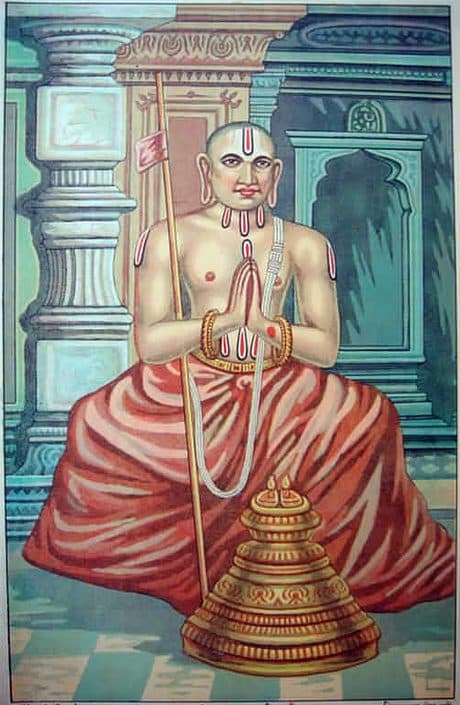
Rāmānuja · Viśiṣṭādvaita
EnglishOn verses 1.20–25
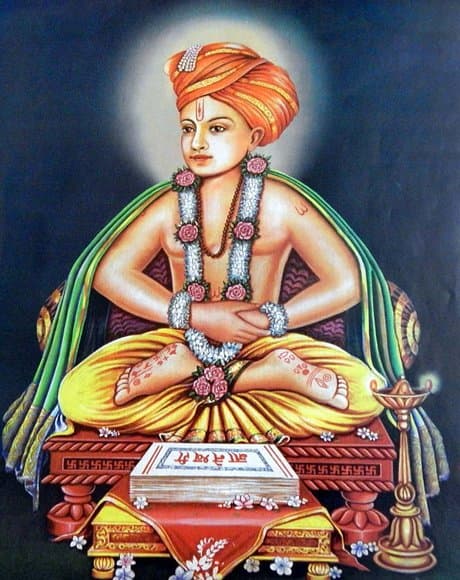
Jñāneśvar · Vārkarī
EnglishOn verses 1.21–1.24
21 "And then addressed these words, O Lord of the Earth, unto (Kṛṣṇa, the) Hṛṣikēśa: 'Station my chariot, O Acyuta, betwixt the two armies. 22 Whilst I just mark these that are arrayed, lusting for combat: (just mark) with whom I have to engage in this (impending) encounter. 23 "I shall just look upon these that have here foregathered ready for fight, and longing to achieve in battle what is dear to the evil-minded (Duryodhana), the son of Dhritarāṣṭra." 24 "(Kṛṣṇa, the) Hṛṣīkeśa, thus addressed, O Descendant of Bharata, by (Arjuna, the) Guḍākeśa, stationed that excellent chariot betwixt the two armies." (169)
Arjuna then said, "Lord, take my chariot and station it immediately betwixt the two armies so that I may in a moment make a survey of all the heroes that have arrived here for the battle. All seem to have come here, but I must see who are qualified to fight with me. Almost all—the impatient and bad-tempered—(appear) ambitious in mind for a fight without (possessing) bravery. They have great liking for warfare but lack the courage to stand on the battle-field." Having told thus to the king (Dhritarāṣṭra), hear now what Samjaya says further. Samjaya says: After Arjuna asked him thus, Lord Krishna drove the chariot on and stationed it betwixt the two armies. The chariot was stationed on the spot, where Arjuna saw facing him Bhishma, Drona, and others closely related.
Swami Ramsukhdas · Modern
EnglishOn verses 1.24–1.25
'Guḍākeśena'—'Guḍākeśa' has two meanings (i) 'Guḍā' means 'curled' and 'Keśa' means 'hair.' It means one having curly hair (ii) 'Guḍākā' means 'sleep' and 'Īśa' means 'master.' It means, one who has conquered sleep. Arjuna had curly hair and he had conquered sleep. So he has been called 'Guḍākeśa'.
'Evamuktaḥ'—One, who is not a slave to sleep, idleness and worldly pleasures, but is a slave (devotee) to God; God listens to such a person and even obeys him. Having said so, in order to carry out the wish of his devotee-friend Arjuna, Lord Kṛṣṇa, placed the chariot between the two armies.
'Hṛṣikeśaḥ'—'Hṛṣika' means 'senses' and 'Īśa' means 'Lord.' Thus 'Hṛṣikeśa' means the Lord of the senses. In the twenty-first verse and also in this verse, this word has been used because Lord Kṛṣṇa, who is the inspirer of minds, intellects and senses and who commands the whole world, has become a chariot-driver to carry out Arjuna's wish. It shows how kind He is to Arjuna.
'Senayorubhayormadhye sthāpayitvā rathottamam'—Lord Kṛṣṇa stationed Arjuna's noble chariot in the open space, between the two armies.
'Bhiṣmadroṇapramukhataḥ sarveṣām ca mahikṣitām'—Lord Kṛṣṇa placed the chariot with His sagacity, at such a point from where his kinsmen such as Bhiṣma, his preceptor Droṇa and chief kings and warriors of Kaurava-army, could be clearly seen.
'Uvāca pārtha paśyaltān samavetānkurūniti'—In the word 'Kuru', the sons of both Dhṛtarāṣṭra and Pāṇḍu are included,
because both of them belong to the Kuru family. Lord Kṛṣṇa, by saying 'Behold all these Kurus assembled here' means, that by seeing them, Arjuna may think that they are all one, whether they are on his side or on the opposite side and whether they are good or bad and thus a feeling of kinship may develop in him. This feeling of kinship may lead to attachment and make him inquisitive. Thus, by making Arjuna an instrument, Lord Kṛṣṇa wants to preach the gospel of the Gītā for the benediction of the creatures of Kali-age. Therefore, Lord Kṛṣṇa, instead of using 'Dhārtarāṣṭrān', used the words 'Kurūn'. If he had used 'Dhārtarāṣṭrān', Arjuna would have become enthusiastic and Lord Kṛṣṇa, could not have got a chance to preach the gospel of the Gītā and Arjuna's delusion, born of kinship, could not have been destroyed. But, Lord Kṛṣṇa, thought it His duty to destroy Arjuna's delusion. As a surgeon, first gives medicine, to a patient suffering from a boil so that it may suppurate and then performs an operation, to remove the diseased part, in the same way, God first arouses the hidden delusion of Arjuna and then destroys it. Here, Lord Kṛṣṇa by using the phrase 'kurūn paśya' first arouses delusion in order to destroy it, by advice later.
Arjuna in the twenty-second and twenty-third verses of this chapter wanted to behold and observe them. So Lord Kṛṣṇa says, 'Behold these Kurus.' Lord Kṛṣṇa could have placed the chariot without uttering any words but he intentionally used the phrase 'kurūn paśya' to arouse attachment in Arjuna.
There is a vast difference, between love for the family and love for God though there is also a little similarity. When we have love for members of our family, we overlook their faults, because we have a feeling of mineness with them. Similarly, God also does not heed the shortcomings of His devotee, because He has the feeling that he is His own. But, in domestic love, importance is attached to matters such as body etc., while in love for God, there is importance of feelings. In family love,
there is importance of delusion, while in love for God, there is importance of alliance. In family-love, there is darkness, while in divine love, there is light. In family-love, a man is negligent of his duty, while in love for God, being engrossed in love, a man may forget his duty momentarily, but is never negligent of his duty. In family-love, there is pre-eminence of the family, while in love for God, there is pre-eminence of God.
*Link:—In the above-mentioned verse, Lord Kṛṣṇa told Arjuna to behold the Kurus. In the next verse, Sañjaya describes what happened after that.*
Jñāneśvar · Vārkarī
Marathiआइका अर्जुन इतुकें बोलिला । तंव कृष्णें रथु पेलिला । दोहीं सैन्यामाजि केला । उभा तेणें ॥ १७४॥
Jñāneśvar · Vārkarī
Hindi(1.174) सुनिए, अर्जुन के ऐसा कहते ही श्रीकृष्ण ने रथ आगे बढ़ाया और दोनों सेनाओं के बीच खड़ा कर दिया।
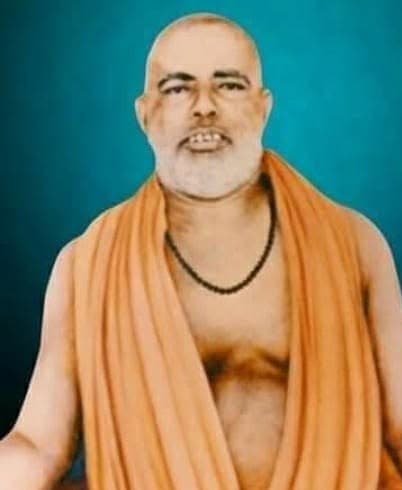
Sri Udiya Baba · Modern
HindiOn verses 1.24–1.25
संजय बोला— जब अर्जुन ने श्रीकृष्ण से ऐसा कहा तब दोनों सेनाओं के मध्य में भीष्म-द्रोण आदि समस्त राजाओं के सम्मुख उस उत्तम रथ को खड़ा करके श्रीकृष्ण ने कहा कि पार्थ! यहाँ एकत्रित हुए इन कौरवों को देखो।
Swami Ramsukhdas · Modern
HindiOn verses 1.24–1.25
'गुडाकेशन'—'गुडाकेश' शब्दके दो अर्थ होते हैं—(१) 'गुडा' नाम मुड़े हुएका है और 'केश' नाम बालोंका है। जिसके सिरके बाल मुड़े हुए अर्थात् घुँघराले हैं, उसका नाम 'गुडाकेश' है। (२) 'गुडाका' नाम निद्राका है और 'ईश' नाम स्वामीका है। जो निद्राका स्वामी है अर्थात् निद्रा ले चाहे न ले—ऐसा जिसका निद्रापर अधिकार है, उसका नाम 'गुडाकेश' है। अर्जुनके केश घुँघराले थे और उनका निद्रापर आधिपत्य था; अतः उनको 'गुडाकेश' कहा गया है।
'एवमुक्तः'—जो निद्रा-आलस्यके सुखका गुलाम नहीं होता और जो विषय-भोगोंका दास नहीं होता, केवल भगवान्का ही दास (भक्त) होता है, उस भक्तकी बात भगवान् सुनते हैं; केवल सुनते ही नहीं, उसकी आज्ञाका पालन भी करते हैं। इसलिये अपने सखा भक्त अर्जुनके द्वारा आज्ञा देनेपर अन्तर्यामी भगवान् श्रीकृष्णने दोनों सेनाओंके बीचमें अर्जुनका रथ खड़ा कर दिया।
'हृषीकेशः'—इन्द्रियोंका नाम 'हृषीक' है। जो इन्द्रियोंके ईश अर्थात् स्वामी हैं, उनको हृषीकेश कहते हैं। पहले इक्कीसवें श्लोकमें और यहाँ 'हृषीकेश' कहनेका तात्पर्य है कि जो मन, बुद्धि, इन्द्रियाँ आदि सबके प्रेरक हैं, सबको आज्ञा देनेवाले हैं, वे ही अन्तर्यामी भगवान् यहाँ अर्जुनकी आज्ञाका पालन करनेवाले बन गये हैं! यह उनकी अर्जुनपर कितनी अधिक कृपा है!
'सेनयोरुभयोर्यथे स्थापयित्वा रथोत्तमम्'—दोनों सेनाओंके बीचमें जहाँ खाली जगह थी, वहाँ भगवान्ने अर्जुनके श्रेष्ठ रथको खड़ा कर दिया।
'भीष्मद्रोणप्रमुखतः सर्वेषां च महीक्षिताम्'—उस रथको भी भगवान्ने विलक्षण चतुराईसे ऐसी जगह खड़ा किया, जहाँसे अर्जुनको कौटुम्बिक सम्बन्धवाले पितामह भीष्म, विद्याके सम्बन्धवाले आचार्य द्रोण एवं कौरव-
सेनाके मुख्य-मुख्य राजालोग सामने दिखायी दे सकें।
'उवाच पार्थ पश्यैतान्समवेतान्कुरूनिति'—'कुरु' पदमें धृतराष्ट्रके पुत्र और पाण्डुके पुत्र—ये दोनों आ जाते हैं; क्योंकि ये दोनों ही कुरुवंशी हैं। युद्धके लिये एकत्र हुए इन कुरुवंशियोंको देख—ऐसा कहनेका तात्पर्य है कि इन कुरुवंशियोंको देखकर अर्जुनके भीतर यह भाव पैदा हो जाय कि हम सब एक ही तो हैं! इस पक्षके हों, चाहे उस पक्षके हों; भले हों, चाहे बुरे हों; सदाचारी हों, चाहे दुराचारी हों; पर हैं सब अपने ही कुटुम्बी। इस कारण अर्जुनमें छिपा हुआ कौटुम्बिक ममतायुक्त मोह जाग्रत् हो जाय और मोह जाग्रत् होनेसे अर्जुन जिज्ञासु बन जाय, जिससे अर्जुनको निमित्त बनाकर भावी कलियुगी जीवोंके कल्याणके लिये गीताका महान् उपदेश दिया जा सके—इसी भावसे भगवान्ने यहाँ 'पश्यैतान् समवेतान् कुरून्' कहा है। नहीं तो भगवान् 'पश्यैतान् धार्तराष्ट्रान् समानिति'—ऐसा भी कह सकते थे; परन्तु ऐसा कहनेसे अर्जुनके भीतर युद्ध करनेका जोश आता; जिससे गीताके प्राकट्यका अवसर ही नहीं आता! और अर्जुनके भीतरका प्रसुप्त कौटुम्बिक मोह भी दूर नहीं होता, जिसको दूर करना भगवान् अपनी जिम्मेवारी मानते हैं। जैसे कोई फोड़ा हो जाता है तो वैद्यलोग पहले उसको पकानेकी चेष्टा करते हैं और जब वह पक जाता है, तब उसको चौरा देकर साफ कर देते हैं; ऐसे ही भगवान् भक्तके भीतर छिपे हुए मोहको पहले जाग्रत् करके फिर उसको मिटाते हैं। यहाँ भी भगवान् अर्जुनके भीतर छिपे हुए मोहको 'कुरून् पश्य' कहकर जाग्रत् कर रहे हैं, जिसको आगे उपदेश देकर नष्ट कर देंगे।
अर्जुनने कहा था कि 'इनको मैं देख लूँ'—'निरीक्षे' (१। २२) 'अवेशे' (१। २३); अतः यहाँ भगवान्को 'पश्य' (तू देख ले)—ऐसा कहनेकी जरूरत ही नहीं थी। भगवान्को तो केवल रथ खड़ा कर देना चाहिये था। परन्तु
भगवानने रथ खड़ा करके अर्जुनके मोहको जाग्रत करनेके लिये ही 'कुरुन् पश्य' (इन कुरुवंशियोंको देख)—ऐसा कहा है।
कौटुम्बिक स्नेह और भगवत्प्रेम—इन दोनोंमें बहुत अन्तर है। कुटुम्बमें ममतायुक्त स्नेह हो जाता है तो कुटुम्बके अवगुणोंकी तरफ खयाल जाता ही नहीं; किंतु 'ये मेरे हैं'—ऐसा भाव रहता है। ऐसे ही भगवान्का भक्तमें विशेष स्नेह हो जाता है तो भक्तके अवगुणोंकी तरफ भगवान्का खयाल जाता ही नहीं; किन्तु 'यह मेरा ही है'—
ऐसा ही भाव रहता है। कौटुम्बिक स्नेहमें क्रिया तथा पदार्थ—(शरीरादि-) की और भगवत्प्रेममें भावकी मुख्यता रहती है। कौटुम्बिक स्नेहमें मूढ़ता—(मोह-) की और भगवत्प्रेममें आत्मीयताकी मुख्यता रहती है। कौटुम्बिक स्नेहमें अंधेरा और भगवत्प्रेममें प्रकाश रहता है। कौटुम्बिक स्नेहमें मनुष्य कर्तव्यच्युत हो जाता है और भगवत्प्रेममें तल्लीनताके कारण कर्तव्य-पालनमें विस्मृति तो हो सकती है, पर भक्त कभी कर्तव्यच्युत नहीं होता। कौटुम्बिक स्नेहमें कुटुम्बियोंकी और भगवत्प्रेममें भगवान्की प्रधानता होती है।
सम्बन्ध—पूर्वश्लोकमें भगवान्ने अर्जुनसे कुरुवंशियोंको देखनेके लिये कहा। उसके बाद क्या हुआ—इसका वर्णन संजय आगेके श्लोकमें करते हैं।
After attentively surveying the army of the Kaurāvas arranged in battle formation, Arjuna, the son of Pāṇḍu on whose flag bears the image of Hanuman, who set the kingdom of Lanka ablaze, requested Lord Krishna to place their chariot between the two opposing armies.
Requested whom?
Arjuna requested no lesser personality than the Supreme Lord Himself, the treasure-house of such attributes as wisdom, strength, sovereignty, eternality, omnipotence and splendour.
Who by His will created the complete cosmic manifestation in its triple aspect of Inception, Preservation and Dissolution for His own pleasure as in sport, the Supreme Lord Krishna, Hriṣīkeśa, the master of the senses, the Supreme Controller, internally and externally of all living entities evolving and evolved.
Who, although the Supreme Lord of all, yet descended down to Earth out of His causeless mercy for the redemption of the faithful and even more, He condescended to be Arjuna's chariot driver,
carrying out his wish to station their chariot in such a commanding position as to be able to readily view the belligerent Kaurāvas and put within the range of his vision such heroes as Bhīshma-dēva, Droṇāchārya and Kripā and the Kings of royal dynasties.
At that time the Supreme Lord Krishna said to Arjuna: see what chances there are for the Kaurāvas victory over thee.