

Bhagavad Gītā · Chapter 1 · Arjuna Viṣāda Yoga
सञ्जय उवाच
दृष्ट्वा तु पाण्डवानीकं व्यूढं दुर्योधनस्तदा
आचार्यमुपसङ्गम्य राजा वचनमब्रवीत्
sañjaya uvāca
dṛṣṭvā tu pāṇḍavānīkaṃ vyūḍhaṃ duryodhanastadā|
ācāryamupasaṅgamya rājā vacanamabravīt||
Word meanings
तदा = then
व्यूढम् = arrayed in battle formation
पाण्डवानीकम् = the army of the Pāṇḍavas
दृष्ट्वा = having seen
तु = then
आचार्यम् = the teacher (Droṇa)
उपसङ्गम्य = having approached
राजा = the king
दुर्योधनः = Duryodhana
वचनम् = these words
अब्रवीत् = said
Translation
Sañjaya said: At that time, seeing the army of the Pandavas drawn up for battle and approaching Dronacarya King Duryodhana spoke these words:
Commentary
The commentators seated around this verse
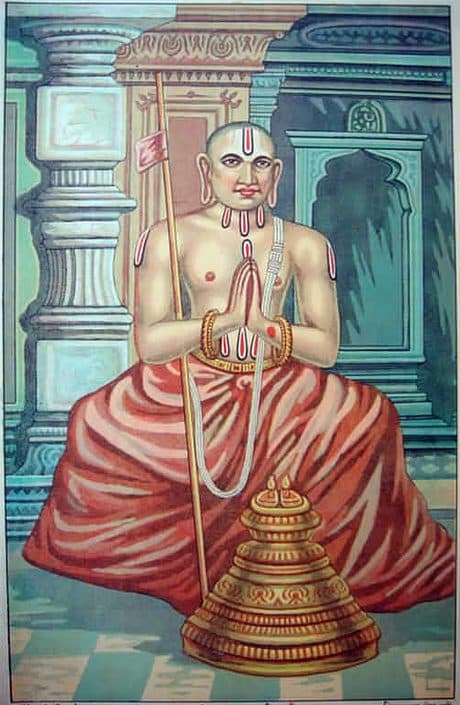
Rāmānuja · Viśiṣṭādvaita
EnglishOn verses 1.1–19
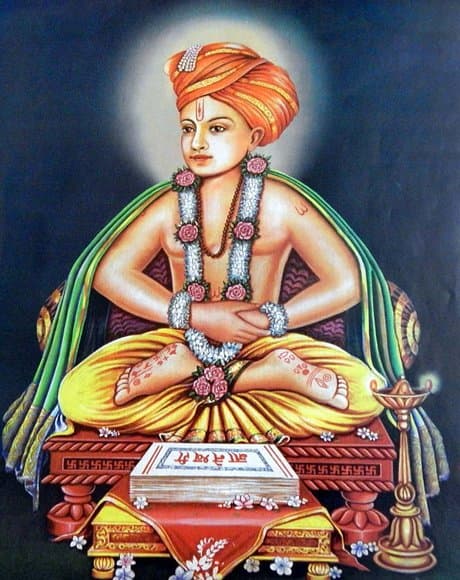
Jñāneśvar · Vārkarī
EnglishOn verses 1.2–1.3
2 Saṃjaya Spake “Noticing the Pāṇḍava-host arrayed for battle, Duryodhana the King thereupon approached the Preceptor (Drona), and uttered this word: 3 “Behold, Preceptor, this mighty host of Pāṇḍu’s sons, drawn in battle-array by Drupada’s son—thy talented disciple. (88)
Saṃjaya then said “The Pāṇḍava Army has got so terribly excited that it looks like the mouth of the destroyer getting widened as at the time of the world dissolution. In that way the immensely massive army got suddenly astir just as the subtle venom gets out of control when gushing out: or just as the forest fire when fanned and spread out by stormy winds seeketh to reach the very heights of the sky after absorbing dry the ocean water. In that way the Pāṇḍava Army ready with impregnable defence-arrangements looked formidable at that time. Duryodhana seeing this treated it with contempt in the way a lion ignores a herd of elephants: approaching Dronāchārya, (Duryodhana) enquired if he saw how the Pāṇḍava army had got elated. “These different battle formations all around which appear like moving mountain fortresses have been constructed by that dull-headed Dhrishtadyumna: oh, see, see, it is he whom you trained and made expert by giving him the art that has spread this ocean of army.
Swami Ramsukhdas · Modern
English‘Tadā’—‘Tadā’, means the time when both the armies were arrayed and Dhṛtarāṣṭra was very much anxious to hear the account of the battlefield.
‘Tu’—Dhṛtarāṣṭra put the question about his sons and the sons of Pāṇḍu. So Sañjaya uses the word ‘Tu’, to tell Dhṛtarāṣṭra first about his sons.
‘Dṛṣṭvā* pāṇḍavānikam vyūḍham’—It means that the army of the Pāṇḍavas was arrayed in good order viz., the warriors had no difference in their opinion†. Righteousness, and Lord Kṛṣṇa, were in their favour. Therefore, the Pāṇḍavas, though fewer in number, had greater impact. Seeing their army arrayed, Duryodhana was also influenced. So he, approaching Droṇācārya, spoke prudent and serious words.
‘Rājā Duryodhanaḥ’—Duryodhana was called ‘Rājā’, the king, because Dhṛtarāṣṭra had the greatest attachment and affection for Duryodhana. Moreover, Duryodhana was the prince. He looked after the affairs of the empire, while Dhṛtarāṣṭra was only the nominal head. Duryodhana was the main cause of the warfare also. It was because of all these factors, that he was called king by Sañjaya.
* In this chapter the term ‘Dṛṣṭvā’ has been used three times—seeing the Pāṇḍava-army, Duryodhana approaches Droṇācārya (1/2); seeing the Kaurava-army, Arjuna lifts his bow (1/20); seeing his kith and kin, Arjuna is filled with extreme passion (1/28). In the first two cases the term ‘Dṛṣṭvā’ has been used for seeing the army while the third time it has been used for seeing the kith and kin which changes Arjuna’s feeling.
† There was a difference of opinions in the Kaurava-army because Duryodhana and Duḥśāsana etc., wanted to wage the war. But Bhīṣma, Droṇa and Vikarṇa did not want. And there is a rule that where there is difference in opinions, there vigour subsides.
**‘Ācāryamupasaṅgamya’**—It seems, that there were three reasons why Duryodhana approached Droṇācārya:—
(i) He went for his selfish interest, so that he could arouse ill-will in Droṇācārya’s heart, against the Pāṇḍavas and Droṇācārya might be specially partial to his army.
(ii) It was proper on his part to go to Droṇācārya, to express his regard for him, because he was his preceptor.
(iii) It is very significant, for the chief warrior not to leave his position otherwise the whole order of the army is disturbed. So, it was proper on the part of Duryodhana, to go to Droṇācārya.
Here a question may be raised that, Duryodhana should have first of all approached Bhīṣma because Bhīṣma was the commander supreme. Then, why did he approach Droṇācārya? The answer is, that Droṇa and Bhīṣma both loved the Pāṇḍavas, and the Kauravas, but Droṇa had special kindness and love for Arjuna. Moreover, Duryodhana had a pupil-preceptor relationship with Droṇa, but he had no family relationship with him. Therefore, it was proper on his part to go to Droṇa, to please him. In practical life also it is seen that a man for his selfish interest, tries to please a person who is not closely related to him, by offering him regard.
Duryodhana thought, that Bhīṣma was his grandfather. So it was easy to please him, even if he was displeased, because of his family relationship. So Bhīṣma, also loved him very much. Bhīṣma, blew his conch loudly, to please and cheer up Duryodhana (1/12).
**‘Vacanaṃabravīt’**—Here, it was sufficient to use the word ‘Abravīt’ (spoke), which also includes ‘Vacanaṃ’ (words). So there was no need to use the word ‘Vacanaṃ’. Even then, the term ‘Vacanaṃ’ has been used, which shows that Duryodhana spoke prudent and meaningful words, in order to arouse ill-will in Droṇācārya’s heart, against the Pāṇḍavas and to win his favour, so that he could fight whole-heartedly, on the Kauravas
side and they would gain victory. Thus the term 'Vacanam' was used with a selfish motive.
*Link:—Duryodhana approaching Droṇa speaks the following words:—*
Jñāneśvar · Vārkarī
Marathiतिये वेळी तो संजय बोले । म्हणे पांडवसैन्य उचलले । जैसें महाप्रळयीं पसरले । कृतांतमुख ॥ ८८॥
तैसे तें घनदाट । उठावले एकवाट । जैसें उसळले कालकूट । धरीं कणव ॥ ८९॥
ना तरी वडवानलु सादुकला । प्रलयवाते पोखला । सागर शोषूनि उधवला । अंबरासी ॥ ९०॥
तैसे दळ दुर्धर । नाना व्यूहीं परिकर । अवगमले भयासुर । तिये काळीं ॥ ९१॥
तें देखिलेयां दुर्योधनें । अव्हेरिले कवणे माने । जैसें न गणिजे पंचाननें । गजवटांते ॥ ९२ ॥
Jñāneśvar · Vārkarī
HindiOn verses 1.2–1.3
(1.88) संजय ने कहा — प्रथम पाण्डवों की सेना ऐसी क्षुब्ध हो गई कि जैसे महाप्रलय के समय कृतान्त ने मुँह फैलाया हो।
(1.89) वह अत्यन्त सघन सेना एकदम भभक उठी; जैसे कालकूट विष क्षुब्ध हो कर सब दूर छा जाये तो उसे कौन शमन कर सकता है? (1.90) अथवा जैसे बड़वानल प्रलय-काल की वायु से पुष्ट होकर समुद्र का शोषण करता है और उससे आकाश तक प्रदीप्त हो जाता है,
(1.91) वैसे ही यह दुर्धर सेना नाना प्रकार के व्यूहों से रची हुई मुझे उस समय भयानक दिखाई दी।
(1.92) उसे देखकर दुर्योधन ने उसका इस तरह तिरस्कार किया कि जैसे सिंह हाथियों के समूह की परवा नहीं करता।
(1.93) फिर वह द्रोण के पास आया और उनसे कहने लगा कि देखो, पाण्डवों का दल कैसा भभक रहा है।
(1.94) बुद्धिमान द्रुपद-पुत्र (धृष्टद्युम्न) ने इस सेना में चहुँओर अनेक व्यूह रचे हैं जो मानों चलते पहाड़ी किले ही हैं।
(1.95) देखिए, आपने जिस शिष्य को अपनी विद्या का आश्रयस्थान बनाया है उसी ने इस सेनारूपी समुद्र का विस्तार किया है।
Sri Udiya Baba · Modern
Hindiसञ्जय बोले—तब राजा दुर्योधन ने व्यूह के आकार में सुव्यवस्थित पाण्डव सेना को देखकर द्रोण के पास जाकर ये वचन कहे।
Swami Ramsukhdas · Modern
Hindi'तदा'—जिस समय दोनों सेनाएँ युद्धके लिये खड़ी हुई थीं, उस समयकी बात संजय यहाँ 'तदा' पदसे कहते हैं। कारण कि धृतराष्ट्रका प्रश्न 'युद्धकी इच्छावाले मेरे और पाण्डुके पुत्रोंने क्या किया'—इस विषयको सुननेके लिये ही है।
'दृष्ट्वा' पाण्डवानीकं व्यूढम्'—पाण्डवोंकी वज्रव्यूह-से खड़ी सेनाको देखनेका तात्पर्य है कि पाण्डवोंकी सेना बड़ी ही सुचारूपसे और एक ही भावसे खड़ी थी अर्थात् उनके सैनिकोंमें दो भाव नहीं थे, मतभेद नहीं था। उनके पक्षमें धर्म और भगवान् श्रीकृष्ण थे। जिसके पक्षमें धर्म और भगवान् होते हैं, उसका दूसरोंपर बड़ा असर
पड़ता है। इसलिये संख्यामें कम होनेपर भी पाण्डवोंकी सेनाका तेज (प्रभाव) था और उसका दूसरोंपर बड़ा असर पड़ता था। अतः पाण्डव-सेनाका दुर्योधनपर भी बड़ा असर पड़ा, जिससे वह द्रोणाचार्यके पास जाकर नीतियुक्त गंभीर वचन बोलता है।
'राजा दुर्योधनः'—दुर्योधनको राजा कहनेका तात्पर्य है कि धृतराष्ट्रका सबसे अधिक अपनापन (मोह) दुर्योधनमें ही था। परम्पराकी दृष्टिसे भी युवराज दुर्योधन ही था। राज्यके सब कार्योंकी देखभाल दुर्योधन ही करता था। धृतराष्ट्र तो नाममात्रके राजा थे। युद्ध होनेमें भी मुख्य हेतु दुर्योधन ही था। इन सभी कारणोंसे संजयने दुर्योधनके लिये
१-इस अध्यायमें तीन बार 'दृष्ट्वा' (देखकर) पदका प्रयोग हुआ है—पाण्डव-सेनाको देखकर दुर्योधनका द्रोणाचार्यके पास जाना (१। २); कौरव-सेनाको देखकर अर्जुनका धनुषको उठाना (१। २०); और अपने स्वजनों- (कुटुम्बियों-) को देखकर अर्जुनका मोहाविष्ट होना (१। २८)। इन तीनोंमेंसे दो 'दृष्ट्वा' तो आपसमें सेना देखनेके लिये आये हैं और एक 'दृष्ट्वा' स्वजनोंको देखनेके लिये आया है, जिससे अर्जुनका भाव बदल जाता है।
२-कौरव-सेनामें मतभेद था; क्योंकि दुर्योधन, दुःशासन आदि तो युद्ध करना चाहते थे, पर भीष्म, द्रोण, विकर्ण आदि युद्ध नहीं करना चाहते थे। यह नियम है कि जहाँ आपसमें मतभेद होता है, वहाँ तेज (प्रभाव) नहीं रहता—
काँच कटोरो कुम्भ पय मोती मित अवास। ताल घाव तिरिया कटक फाटा करे बिनास॥
‘राजा’ शब्दका प्रयोग किया है।
‘आचार्यमुपसङ्गम्य’—द्रोणाचार्यके पास जानेमें मुख्यतः तीन कारण मालूम देते हैं—
(१) अपना स्वार्थ सिद्ध करनेके लिये अर्थात् द्रोणाचार्यके भीतर पाण्डवोंके प्रति द्वेष पैदा करके उनको अपने पक्षमें विशेषतासे करनेके लिये दुर्योधन द्रोणाचार्यके पास गया।
(२) व्यवहारमें गुरुके नाते आदर देनेके लिये भी द्रोणाचार्यके पास जाना उचित था।
(३) मुख्य व्यक्तिका सेनामें यथास्थान खड़े रहना बहुत आवश्यक होता है, अन्यथा व्यवस्था बिगड़ जाती है। इसलिये दुर्योधनका द्रोणाचार्यके पास खुद जाना उचित ही था।
यहाँ शंका हो सकती है कि दुर्योधनको तो पितामह भीष्मके पास जाना चाहिये था, जो कि सेनापति थे। पर दुर्योधन गुरु द्रोणाचार्यके पास ही क्यों गया? इसका समाधान यह है कि द्रोण और भीष्म—दोनों उभय-पक्षपाती थे अर्थात् वे कौरव और पाण्डव—दोनोंका ही पक्ष रखते थे। उन दोनोंमें भी द्रोणाचार्यको ज्यादा राजी करना था; क्योंकि द्रोणाचार्यके साथ दुर्योधनका गुरुके नाते तो स्नेह था, पर कुटुम्बके नाते स्नेह नहीं था; और अर्जुनपर द्रोणाचार्यकी विशेष कृपा थी। अतः उनको राजी
करनेके लिये दुर्योधनका उनके पास जाना ही उचित था। व्यवहारमें भी यह देखा जाता है कि जिसके साथ स्नेह नहीं है, उससे अपना स्वार्थ सिद्ध करनेके लिये मनुष्य उसको ज्यादा आदर देकर राजी करता है।
दुर्योधनके मनमें यह विश्वास था कि भीष्मजी तो हमारे दादाजी ही हैं; अतः उनके पास न जाऊँ तो भी कोई बात नहीं है। न जानेसे अगर वे नाराज भी हो जायेंगे तो मैं किसी तरहसे उनको राजी कर लूँगा। कारण कि पितामह भीष्मके साथ दुर्योधनका कौटुम्बिक सम्बन्ध और स्नेह था ही, भीष्मका भी उसके साथ कौटुम्बिक सम्बन्ध और स्नेह था। इसलिये भीष्मजीने दुर्योधनको राजी करनेके लिये जोरसे शंख बजाया है (पहले अध्यायका बारहवाँ श्लोक)।
‘वचनमब्रवीत्’—यहाँ ‘अब्रवीत्’ कहना ही पर्याप्त था; क्योंकि ‘अब्रवीत्’ क्रियाके अन्तर्गत ही ‘वचनम्’ आ जाता है अर्थात् दुर्योधन बोलेगा, तो वचन ही बोलेगा। इसलिये यहाँ ‘वचनम्’ शब्दकी आवश्यकता नहीं थी। फिर भी ‘वचनम्’ शब्द देनेका तात्पर्य है कि दुर्योधन नीतियुक्त गम्भीर वचन बोलता है, जिससे द्रोणाचार्यके मनमें पाण्डवोंके प्रति द्वेष पैदा हो जाय और वे हमारे ही पक्षमें रहते हुए ठीक तरहसे युद्ध करें। जिससे हमारी विजय हो जाय, हमारा स्वार्थ सिद्ध हो जाय।
सम्बन्ध—द्रोणाचार्यके पास जाकर दुर्योधन क्या वचन बोला—इसको आगेके श्लोकमें बताते हैं।
Duryodhana while witnessing the strength of the Pāṇḍavas army supported by the might of Bhīmā weighed his own armies strength under the command of Bhīshma
and perceiving the mood of his preceptor Droṇāchārya, he could understand the inadequacy in his own troops and the perfection of strength on the Pāṇḍavas side to be victorious and internally this aggrieved him heavily.
Bhīshma seeing all this gave a roar like a lion and blew a mighty, reverberating blast on his conch-shell which was followed by a tumultuous beating of drums, blaring of horns and blasting of conch-shells as if indicative of the victory in order to cheer up Duryodhana.
Immediately upon hearing this Lord Krishna and Arjuna seated in their majestic chariot capable of conquering all the worlds; both seized their conch-shells and reverberated a sound that shook all the worlds.
Thereafter Bhīmā, Yudhisṭhīra, Nākula and Sahadeva and the rest of the mahā-rathas of the Pāṇḍava army blew their conch-shells
and the roar which was heard cleaved the hearts of Duryodhana and the army of the Kaurāvas and in their hearts they felt that the battle was already lost.
Thus did Sanjaya narrate to Dhritarāshtra whose only concern was for the success of his son Duryodhana and the Kaurāvas in the battle.