Bhagavad Gītā 2.31Open verse
a kṣatriya's own dharma in war
स्वधर्ममपि चावेक्ष्य
न विकम्पितुमर्हसि
Besides: considering your own duty too you should not waver; for there is nothing more welcome for a man of the warrior class than a righteous war.


Concepts
धर्मः
dharmaḥ
From √dhṛ, 'to hold, sustain, uphold' — dharma is what holds a person, a society, and the cosmos in their right place; sva-dharma is the portion of that holding-work that is yours.
कार्पण्यदोषोपहतस्वभावः
पृच्छामि त्वां धर्मसंमूढचेताः
यच्छ्रेयः स्यान्निश्चितं ब्रूहि तन्मे
शिष्यस्तेऽहं शाधि मां त्वां प्रपन्नम्
॥ २.७ ॥
With my very being tainted by the vice of faint-heartedness and my mind puzzled with regard to duty, I am asking you. Tell me that which is decidedly good; I am Your disciple. Pray instruct me, who have put myself into Your hands.
Read in contextArjuna doesn't ask Krishna what is right in the abstract — he says his own nature is overwhelmed and he can no longer tell his dharma from his confusion (dharma-sammūḍha-cetāḥ, 2.7). Most people who ask 'what is my dharma' are standing exactly there.
a kṣatriya's own dharma in war
स्वधर्ममपि चावेक्ष्य
न विकम्पितुमर्हसि
Besides: considering your own duty too you should not waver; for there is nothing more welcome for a man of the warrior class than a righteous war.
one's own dharma, flawed, over another's
श्रेयान्स्वधर्मो विगुणः
परधर्मात्स्वनुष्ठितात्
One's own duty, though devoid of merit, is preferable to the duty of another well performed. Even death in the performance of one's own duty brings blessedness;…
the four orders, by guṇa and karma
चातुर्वर्ण्यं मया
सृष्टं गुणकर्मविभागशः
The four orders of society (the Brahmana, the Ksatriya, the Vaisya and the Sudra) were created by Me classifying them according to the mode of Prakrti predominant in…
imperfect own-duty over another's perfected
श्रेयान्स्वधर्मो विगुणः
परधर्मात्स्वनुष्ठितात्
Better is one's own duty, though devoid of merit, than the duty of another well-performed; for performing the duty ordained by his own nature man does not incur sin.
abandon all dharmas, come to Me alone
सर्वधर्मान्परित्यज्य
मामेकं शरणं व्रज
Resigning all your duties to Me, the all-powerful and all-supporting Lord, take refuge in Me alone. I shall absolve you of all sins, worry not.
Your dharma is the duty that is actually yours — given your place, your nature, and this moment — not a higher calling you should trade it for. The Gītā is blunt about it: your own duty done imperfectly beats someone else's done well (3.35). Śaṅkara treats that duty as what purifies you; Rāmānuja as what you offer the Lord; the Jñāneśvarī answers the obvious complaint — but mine is hard — with a homely truth: bitter medicine, your own, still heals. And if you can't tell your dharma from your confusion right now, you're standing where Arjuna stood. That's where the teaching starts, not where it fails.
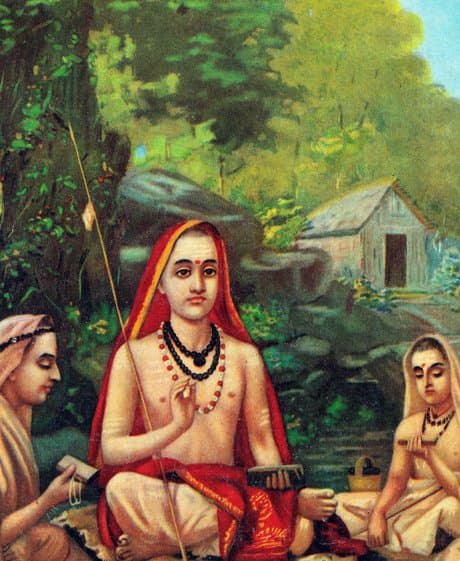
Ādi Śaṅkarācārya · Advaita
Śaṅkara reads svadharma as a discipline of purification, not a final good in itself.
One's own duty, though defective, is superior to, more praiseworthy than, another's duty [well performed].
Bhagavad-Gītā with the Commentary of Śrī Śaṅkarācārya, tr. A. Mahadeva Sastri (1897), on 18.47

Śrī Rāmānuja · Viśiṣṭādvaita
For Rāmānuja the same verse grounds duty in devotion — one's prescribed karma-yoga, offered to Īśvara, outranks a 'better' action that isn't yours to do.
Karma Yoga, even if it is defective in some respects, is better than the Dharma of another, which is well performed.
Gītā-bhāṣya, on 18.47 (translation attribution under review)

Śrī Jñāneśvar · Vārkarī
The Jñāneśvarī answers the obvious objection — but my dharma is hard — with a homely image: bitter medicine, your own, still heals.
Even though one's own Dharma (proper conduct) be difficult to follow, yet one should look to its ultimate fruit.
Jñāneśvarī on 18.47, tr. R. K. Bhagwat (GitaDeep corpus)
Swami Ramsukhdas · Sādhak Sañjīvanī
The practice reading makes svadharma concrete: it is simply the duty of whoever you actually are right now.
A man, having an aim of God-realization, has to perform his duty, according to what he thinks, himself to be. If he thinks that he is a man, he has to perform his duty as a man. If he thinks that he is a teacher, or a student, he has to teach or study.
Sādhak Sañjīvanī on 18.47 — English translation (GitaDeep corpus)
Where the traditions differ, we show the difference.